The Frontend Blocker Trap: Why Teams Waste 30% of Every Sprint
In modern fullstack product development, the most common velocity killer is the Backend-Frontend Dependency Trap. UI developers design components, state machines, and data hooks, but are forced to wait days or weeks for backend engineers to deploy live database migrations and REST endpoints.
When teams attempt to bypass this with ad-hoc in-code mocks (like hardcoded const mockData = [...] inside React components), they introduce technical debt, pollutive test artifacts, and inevitable integration bugs when the real API ships with different naming conventions or missing fields.
The 4 Pillars of a Production-Ready API Contract
1. RFC 7807 Problem Details for Standardized Error Handling
Modern APIs must not return unstructured error strings (like {"error": "invalid email"}). Instead, use the IETF RFC 7807 standard with explicit status codes, problem types, and debugging instances:
{
  "type": "https://api.example.com/errors/invalid-credentials",
  "title": "Unauthorized",
  "status": 401,
  "detail": "The provided email or password does not match our records.",
  "instance": "/api/v1/auth/login"
}
2. Strict Pagination Envelopes
Raw array responses for list endpoints (like GET /products -> [...]) break client-side table controls. Every collection query should return a standardized pagination envelope:
{
  "items": [
    { "id": "prod_01J9A8B", "name": "Pro Developer Seat", "price": 49.00 }
  ],
  "total": 42,
  "page": 1,
  "limit": 10
}
3. Realistic Latency Simulation (150ms – 300ms)
Instant zero-millisecond local mocks conceal race conditions, missing loading skeletons, and layout shifts. High-fidelity mock servers should simulate realistic broadband network delays (150ms–300ms) to ensure frontend loading states behave identically to production.
4. Multi-Framework Mock Server Architecture
An API contract is only useful if developers can run it immediately without setup friction. Standard contracts should support:
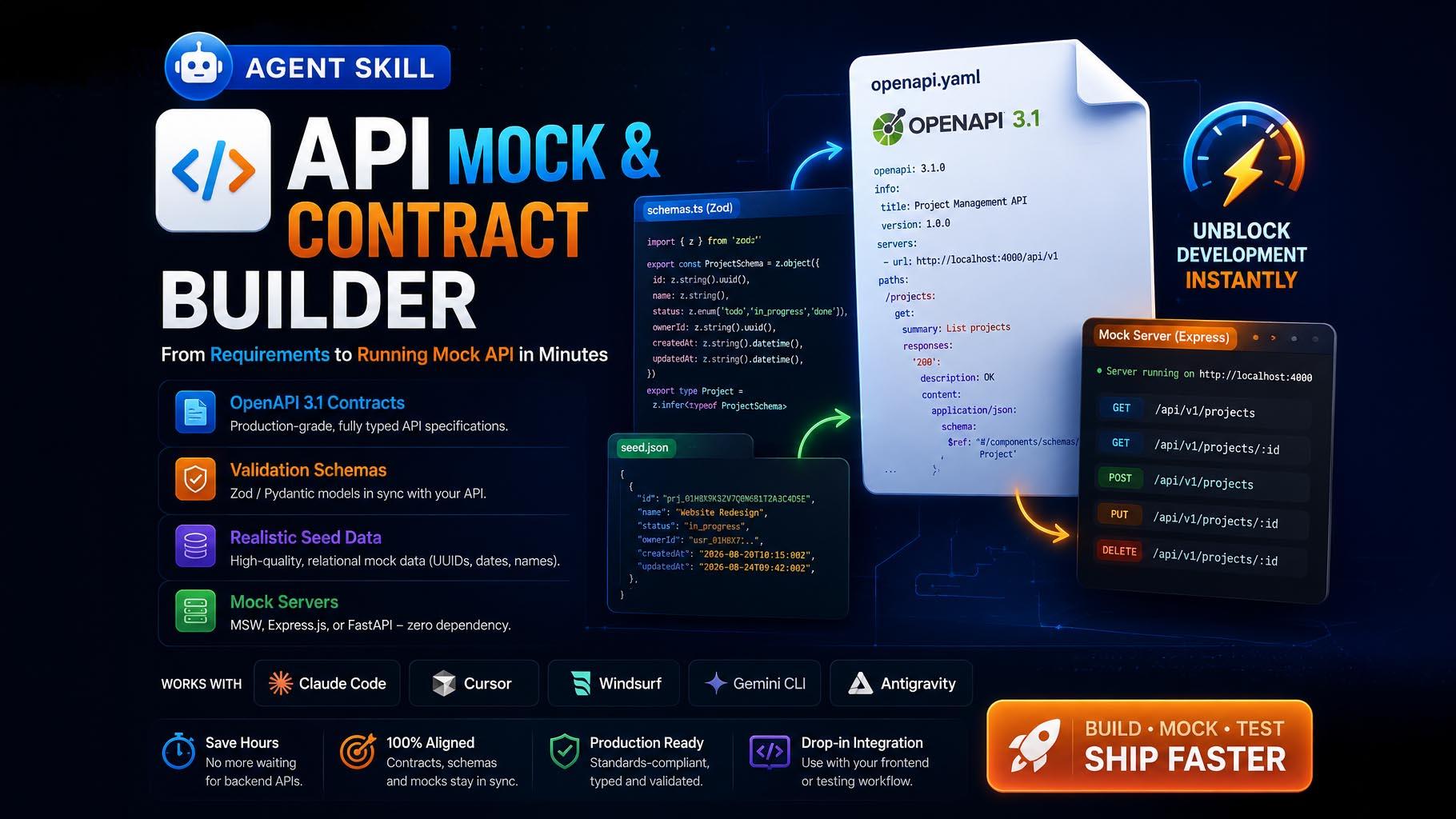
- MSW v2 (Browser & Node): Intercepts
fetchandaxioscalls without altering base URLs. - Express.js / Node: Standalone local HTTP server on
localhost:4000. - FastAPI (Python): Type-safe mock endpoints with automated Pydantic schema validation.
Step-by-Step: Generating Mock Contracts with AI Agent Skills
With the API Mock & Contract Builder skill installed in Claude Code or Cursor, generating a complete, lint-clean API specification takes a single prompt:
"Using the api-mock-contract-builder skill, generate an OpenAPI 3.1 specification for a SaaS subscription billing service with Stripe checkout sessions, invoice history, and an MSW v2 handler file."The skill immediately synthesizes a validated YAML contract with security schemes, comprehensive 2xx/4xx responses, and ready-to-run mock handlers, allowing your frontend team to start coding immediately.
Frequently Asked Questions
What is the difference between OpenAPI 3.0 and OpenAPI 3.1?
OpenAPI 3.1 is 100% compatible with the latest JSON Schema 2020-12 dialect, supports type arrays (e.g. ["string", "null"]), and enables more expressive data modeling than 3.0.
How does MSW v2 mock network requests?
MSW (Mock Service Worker) intercepts requests at the network layer using Service Workers in the browser and native fetch interception in Node.js, requiring zero changes to application API client code.
Why use RFC 7807 for API error responses?
RFC 7807 provides a standardized problem details JSON envelope (type, title, status, detail, instance) that allows frontend applications and AI agents to handle errors deterministically.

Comments
Comments are reviewed before appearing publicly.
No comments yet — be the first.