The Death of the 300-Word Cold Pitch
Most AI-generated cold emails fail for a simple reason: they read like a 300-word corporate essay with a product description, a feature list, and a calendar link crammed into one message. Busy founders and engineering leads check email on their phones and decide in about three seconds whether something's worth reading further, a 300-word pitch fails that test before it ever gets to the actual offer.
The golden rule of cold outreach: high conversion isn't about explaining every feature. It's identifying one specific, real observation, making a low-friction ask, and getting out of the way.
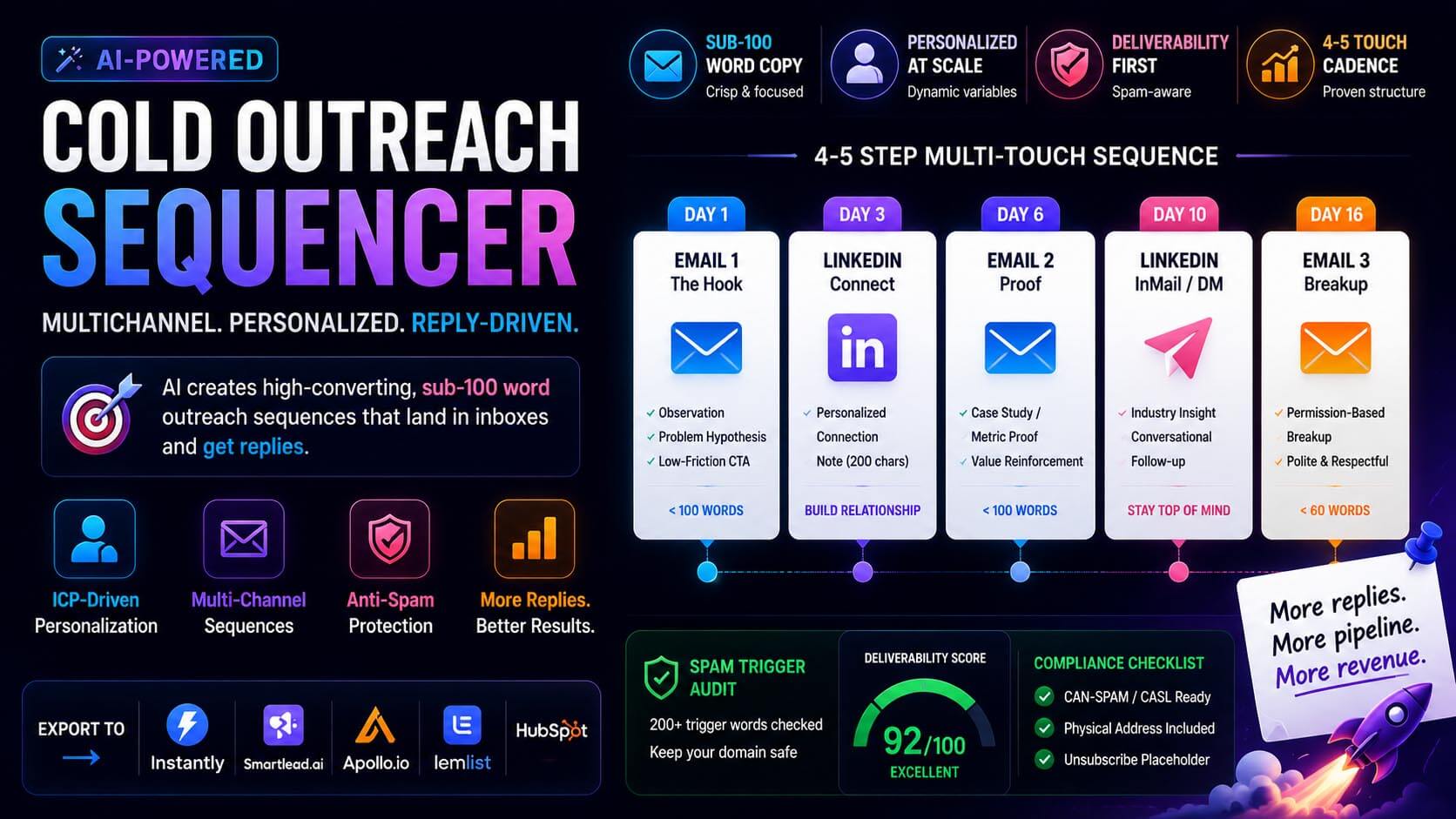
The 4-to-5 Step Multi-Touch Cadence
| Touchpoint | Channel | Optimal Length | Core Objective |
|---|---|---|---|
| Day 1 | Cold Email 1 | 60–90 words | Relevant observation → problem hypothesis → low-friction permission ask |
| Day 3 | LinkedIn Touch | < 200 chars | Blank connection request or a personalized one-sentence observation |
| Day 6 | Cold Email 2 | 50–75 words | One-sentence metric outcome or case study proof |
| Day 10 | LinkedIn InMail / DM | 40–60 words | Conversational follow-up referencing an industry trend |
| Day 16 | Cold Email 3 (Breakup) | 40–50 words | Polite closure that preserves goodwill and leaves the door open |
Example: A Sub-100 Word Cold Email That Actually Gets Read
Subject: quick question for {{company}}

Hi {{first_name}},

Noticed {{company}} recently expanded the frontend engineering team. Typically when scaling past 10 engineers, E2E test suites start breaking on every deploy.

We built a lightweight agent skill that auto-generates resilient Playwright tests with 85%+ branch coverage.

Open to a 3-minute Loom video showing how it works on your repo?

Best,
{{my_name}}

{{physical_address}} | Unsubscribe: {{unsubscribe_link}}
Notice what's missing: no feature list, no case study paragraph, no "book 30 minutes" ask. One observation, one hypothesis, one low-friction question.
Deliverability & CAN-SPAM Compliance Guardrails
- Subject line rule: under 5 words, lowercase or sentence case, zero exclamation points or clickbait.
- Spam trigger filtration: avoid words like
guaranteed,risk-free,100% free,act now. - Compliance placeholders: always include a physical mailing address and an unsubscribe link.
Generating Sequences with Agent Skills
The Multichannel Cold Outreach Sequencer skill writes customized sequences ready to export into Instantly.ai, Smartlead, Apollo, or Lemlist:
"Using the cold-outreach-sequencer skill, write a 4-step multichannel cold sequence targeting VPs of Engineering at Series A SaaS startups for our database optimization skill."
Frequently Asked Questions
Why are cold emails kept under 100 words?
Sub-100 word cold emails respect executive attention spans, render completely on mobile devices without scrolling, and focus the prospect on a single, low-friction reply ask.
What is a low-friction CTA?
Instead of demanding a 30-minute calendar booking, a low-friction CTA asks for interest or permission (e.g. "Open to a 2-min Loom video?", "Worth exploring?").
How does multichannel sequencing improve response rates?
Prospects check different communication channels at different times. Combining email, LinkedIn profile visits, and personalized InMails increases touchpoint visibility without feeling spammy.
Comments
Comments are reviewed before appearing publicly.
No comments yet — be the first.