Most Founders Price by Copying the Nearest Competitor's Number
A team building a database migration tool looks at two competitors, sees $29/mo and $49/mo, and picks $39/mo. That number has no relationship to anything, not their costs, not the value they deliver, not how their usage actually scales per customer. It's the average of two other people's guesses.
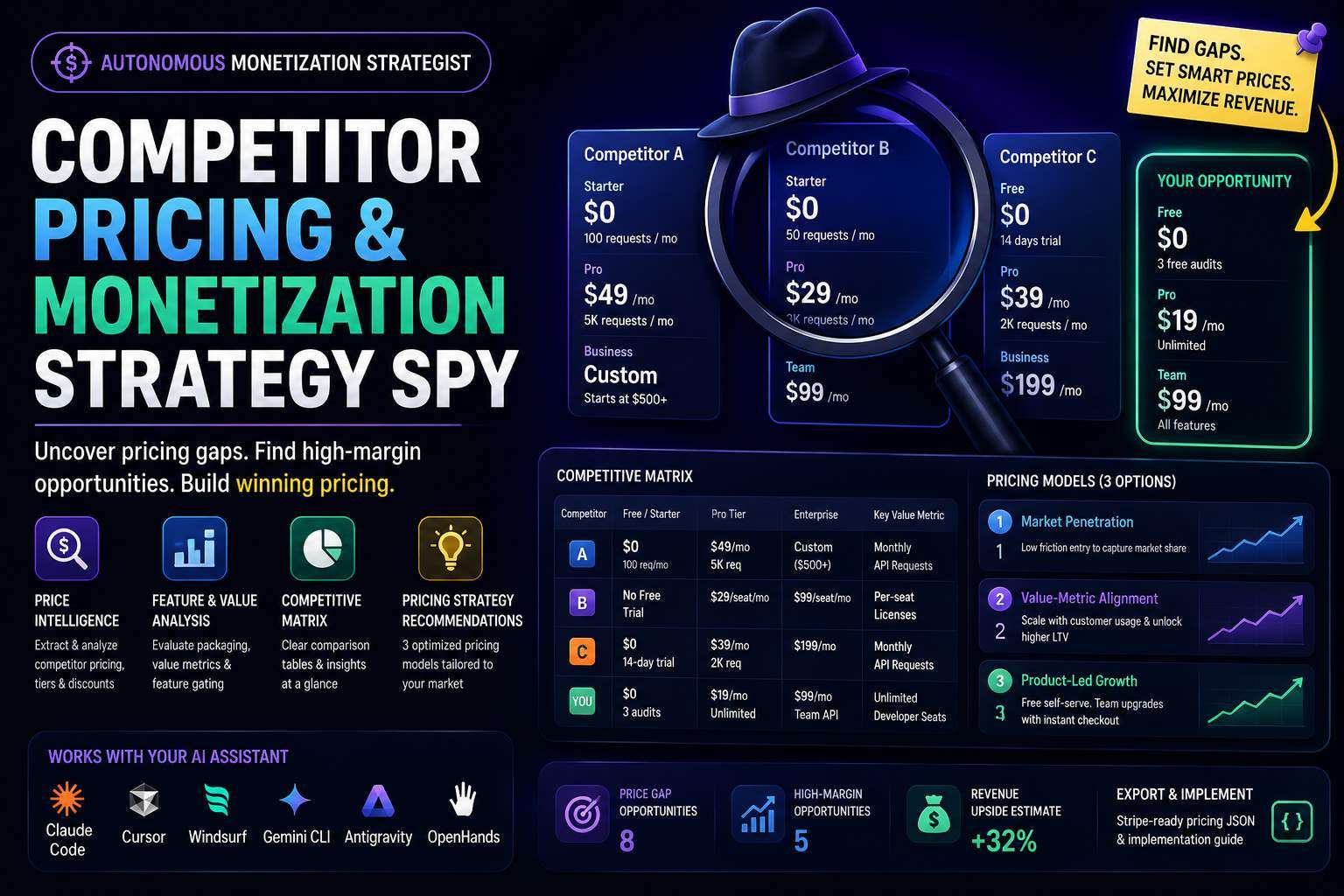
The ai agent for competitor pricing analysis built into the Competitor Pricing & Monetization Strategy Spy skill exists to replace that guess with a structured audit. It ingests competitor pricing pages, tier screenshots, and feature matrices, then runs them through a five-phase workflow that ends in a concrete recommendation and a Stripe schema, not a vibe.
1. Feed It Raw Pricing Data, Not Assumptions
Phase 1 of the skill is ingestion. You hand it pricing URLs, screenshots of competitor tier pages, or raw pasted copy, and it extracts the numbers that actually matter for a pricing decision:
- Entry price and median tier price
- Enterprise thresholds (where "Contact Sales" kicks in)
- Billing cycles, including the annual discount percentage
- Usage caps per tier
This step matters because most competitive research skips straight to "they charge $49/mo" and ignores what that $49 buys. A tool capped at 100 requests a month and a tool with unlimited requests can both cost $49, they're not comparable until the cap is on the table.
2. Diagnose the Value Metric Behind the Sticker Price
Phase 2 is where the skill for competitor pricing spy work actually earns its name. It checks whether a competitor's billing is tied to something that scales with customer success, API calls, team seats, revenue processed, or whether it's arbitrary.
Three specific failure patterns get flagged here:
- Value-metric mismatch, billing on seats when the product's actual value scales with data volume, so a 3-person team using it heavily pays the same as a 3-person team barely touching it.
- Feature-gating hazards, either core functionality locked behind a tier nobody can afford yet, or a free tier so generous that paying customers see no reason to upgrade.
- Psychological anchoring, how the "Most Popular" badge is placed, and whether the billing toggle defaults to Annual or Monthly (defaulting to Annual alone shifts a meaningful share of signups toward the higher-commitment plan).
3. What a Real Competitor Pricing Analysis Table Looks Like
Phase 3 turns the ingested data into a single markdown table. This is the exact shape the skill produces when you feed it two competitors and ask where your own product should sit:
| Competitor | Free / Starter | Pro Tier | Enterprise Tier | Key Value Metric |
|---|---|---|---|---|
| Competitor A | $0 (100 req/mo) | $49/mo (5k req) | Custom ($500+) | Monthly API requests |
| Competitor B | No Free Trial | $29/seat/mo | $99/seat/mo | Per-seat licenses |
| Our Opportunity | $0 (3 free audits) | $19/mo (Unlimited) | $99/mo (Team API) | Unlimited developer seats |
Notice what the table exposes: Competitor A punishes usage growth (5k requests for $49 caps out fast), and Competitor B punishes headcount growth regardless of how much the product is actually used. The "Our Opportunity" row isn't picked at random, it's positioned against the specific weakness each competitor's value metric has.
4. Get Three Pricing Options, Not One Recommendation
Phase 4 doesn't hand back a single number. It formulates three named options, so the decision stays with the founder instead of getting buried in one agent's opinion:
- Option 1, Market Penetration / Low Friction: undercut on price, keep utility high at the entry point.
- Option 2, High-Margin Value-Metric Alignment: price scales smoothly with the customer's own usage, so revenue grows as the customer grows.
- Option 3, Hybrid Product-Led Growth: a genuinely free self-serve tier, with instant credit-card checkout the moment a team needs more.
5. Ship the Pricing Decision as Code, Not a Slide
This is the part most competitor-analysis workflows skip entirely. Phase 5 generates the actual JSON/Stripe product definition, so the pricing decision doesn't die in a strategy doc, it goes straight into your billing system:
{
  "product": {
    "name": "Data Enrichment API, Pro",
    "description": "Unlimited enrichment calls, usage-based overage above 5,000 monthly requests"
  },
  "prices": [
    {
      "nickname": "pro-monthly",
      "unit_amount": 1900,
      "currency": "usd",
      "recurring": { "interval": "month" }
    },
    {
      "nickname": "pro-annual",
      "unit_amount": 17100,
      "currency": "usd",
      "recurring": { "interval": "year" },
      "metadata": { "discount_vs_monthly_pct": "25" }
    },
    {
      "nickname": "pro-overage",
      "unit_amount": 1,
      "currency": "usd",
      "billing_scheme": "per_unit",
      "recurring": { "interval": "month", "usage_type": "metered" },
      "metadata": { "unit": "api_request_above_5000" }
    }
  ]
}
That $171/year annual price isn't rounded, it's $19 × 12 with a 25% discount applied, sitting at the top of the skill's own 15–25% annual-incentive guardrail. Import that object, and the pricing decision is live the same day the audit finished.
The Three Rules the Skill Won't Let You Break
Every recommendation the skill produces has to pass three invariants, regardless of which of the three pricing options you pick:
Running Your Own Competitor Pricing Analysis
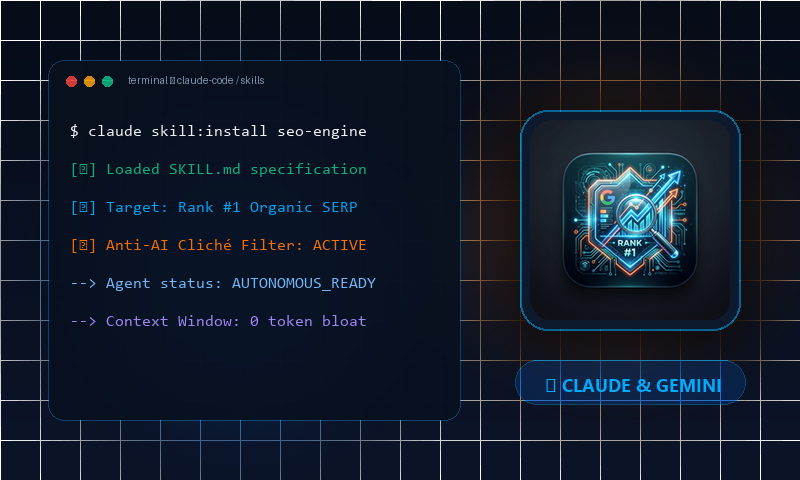
The skill installs like any Claude Code / Cursor / Windsurf agent skill, drop SKILL.md into your assistant's skills directory and call it by name. Two prompts cover most of what teams actually ask for:
"Using the competitor-pricing-spy skill, analyze pricing tiers for the top 3 AI code review tools and formulate our market-entry pricing strategy."
"Using the competitor-pricing-spy skill, design a 3-tier Good-Better-Best pricing model for our B2B data enrichment API."
It's verified against Claude Code, Cursor, Windsurf, Gemini CLI, Antigravity, and OpenHands, and it doesn't need external network permissions, the whole audit runs on the pricing data you feed it inside the session.
Frequently Asked Questions
How does the skill actually analyze competitor pricing structures?
It evaluates the value metric behind each tier (per-seat, usage-based, feature-gated), checks tier anchoring psychology like the decoy effect and Good-Better-Best positioning, and reads customer willingness-to-pay signals from the pricing copy itself.
What does an ai agent for competitor pricing analysis actually output?
A markdown competitive matrix, a feature-gating breakdown flagging over- and under-priced tiers, three named pricing-model options, and a Stripe-ready JSON product definition — not a narrative report you still have to translate into a build task.
Can it catch monetization opportunities a manual audit would miss?
Yes — it specifically looks for underpriced enterprise features (SSO, audit logs, priority SLA) that competitors bury without charging for, and free tiers generous enough that paying customers never feel a reason to convert.
Comments
Comments are reviewed before appearing publicly.
No comments yet — be the first.