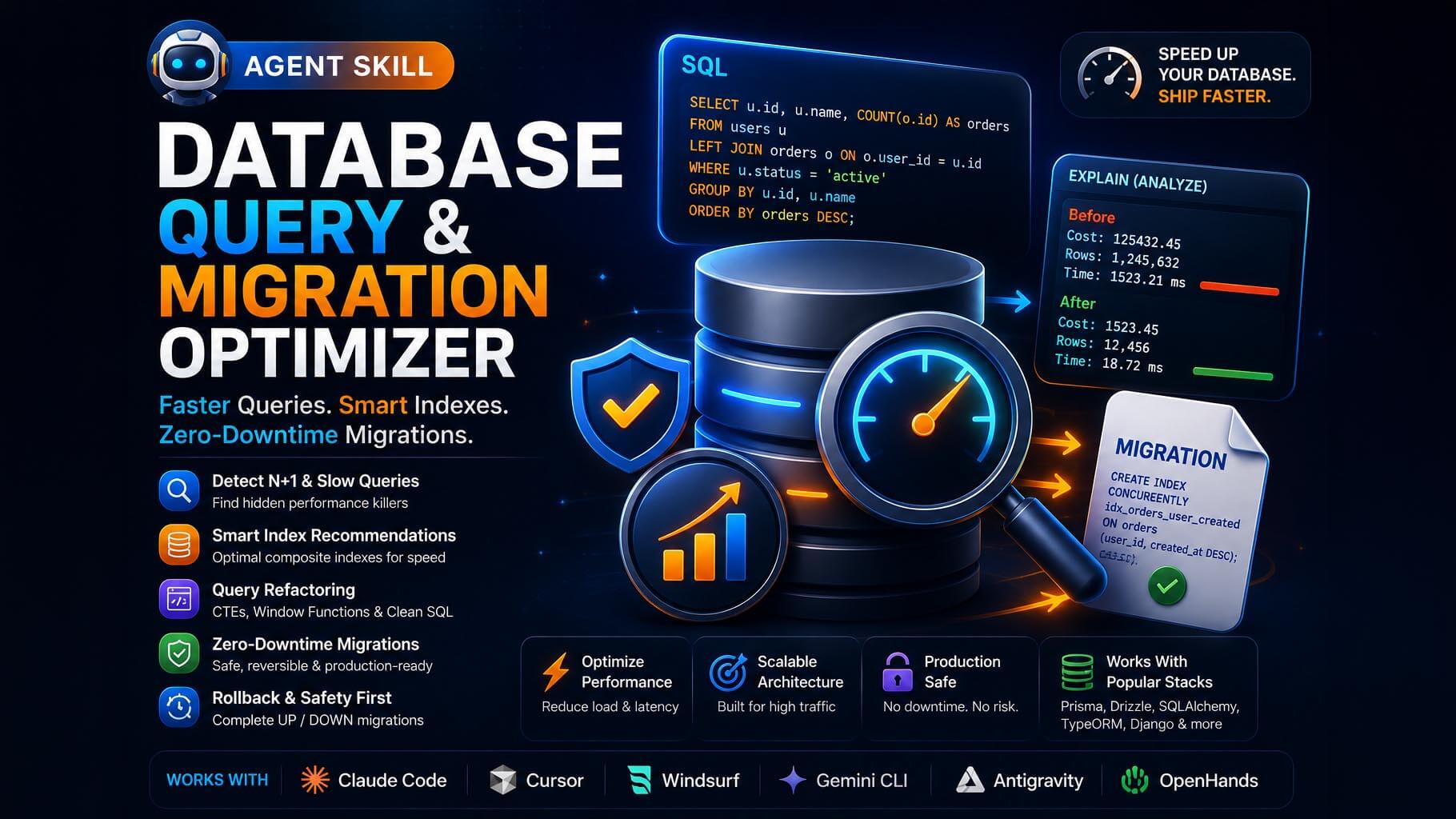
The Hidden Threat of AI-Generated Database Code
AI coding assistants write functional TypeScript and Python in seconds. The catch: they frequently generate naive ORM iteration loops that fire hundreds of unindexed queries under real traffic, causing CPU spikes, exhausted connection pools, and table locks that take down writes for everyone.
We've seen this exact pattern firsthand, a query that runs in 5ms against a 100-row local database can take 8,500ms and lock write transactions when it hits a 2,000,000-row production table. Same code. Different scale.
The 3 Critical Database Bottlenecks, and How to Fix Them
1. N+1 Query Loops
Fetching related data (users and their recent orders, say) via naive iteration executes 1 + N queries, one for the users, then one more per user. Replace it with framework-idiomatic eager loading:
// Prisma: replace loops with include
const users = await prisma.user.findMany({
  where: { active: true },
  include: { orders: { select: { id: true, total: true, createdAt: true } } }
});

# Django ORM: replace loops with select_related / prefetch_related
users = User.objects.filter(is_active=True).select_related('profile').prefetch_related('orders').only('id', 'email', 'profile__tier')
2. The Composite Index Column-Order Rule
For queries mixing filtering and sorting, WHERE user_id = 42 ORDER BY created_at DESC, column order in the B-Tree index isn't cosmetic, it decides whether the index gets used at all:
- Equality first: columns queried with exact equality (
=) go first:(user_id, created_at). - Range and sort second: columns queried with ranges (
>,<,BETWEEN) or used inORDER BYgo last.
3. Keyset (Seek) Pagination vs. OFFSET
High-offset pagination (OFFSET 50000 LIMIT 20) forces the engine to scan and discard 50,020 rows before returning anything. Keyset pagination replaces that scan with an indexed comparison:
-- Slow: O(N) table scan
SELECT * FROM orders ORDER BY created_at DESC LIMIT 20 OFFSET 50000;

-- Fast: O(1) B-Tree seek
SELECT * FROM orders
WHERE (created_at, id) < (:last_seen_created_at, :last_seen_id)
ORDER BY created_at DESC, id DESC
LIMIT 20;
Locking-Impact Classified Migrations Across Dialects
| Database Dialect | Migration Syntax (Classify Locking Impact by Engine/Version) |
|---|---|
| PostgreSQL | CREATE INDEX CONCURRENTLY idx_orders_user_created ON orders (user_id, created_at DESC); |
| MySQL 8.0+ / MariaDB | ALTER TABLE orders ADD INDEX idx_orders_user_created (user_id, created_at DESC), ALGORITHM=INPLACE, LOCK=NONE; |
| SQLite | PRAGMA journal_mode=WAL; CREATE INDEX idx_orders_user_created ON orders (user_id, created_at DESC); |
The plain CREATE INDEX (no CONCURRENTLY) takes an exclusive lock on the table for the duration of the build. On a small staging table that finishes in under a second and nobody notices. On a production table with real traffic, it can stall every write for minutes.
Automating Audits with Agent Skills
The Database Query & Migration Optimizer skill reads your schemas and routes and turns the findings above into drop-in patches and safe migration scripts:
"Using the database-query-optimizer skill, audit my Prisma schema and order routes for PostgreSQL. Identify missing indexes and generate migrations classified by their actual locking impact."
Frequently Asked Questions
Why do ORM models cause N+1 query bottlenecks?
ORMs often lazily fetch related child entities inside loop iterations, executing hundreds of individual SELECT statements instead of a single eager-loading JOIN or batch query.
How does zero-downtime index creation work in PostgreSQL?
Standard CREATE INDEX locks the table against writes. Using CREATE INDEX CONCURRENTLY builds the index in the background without acquiring an exclusive table lock.
What is the advantage of Keyset pagination over OFFSET?
OFFSET 100000 requires the database engine to scan and discard 100,000 rows in memory before returning results. Keyset pagination uses indexed WHERE comparison operators for constant O(1) speed.

Comments
Comments are reviewed before appearing publicly.
No comments yet — be the first.