1. The Context Paradox: Why 1M-Token Context Windows Still Produce Bugs
Modern large language models now ship with context windows between 200k and 1M+ tokens. Developers running Claude Code, Cursor, Windsurf, and other MCP-compatible coding agents still watch them hallucinate database tables that don't exist, override a security rule two messages after it was set, or drop a decision the team settled on three prompts back.
The cause sits in information density, not context size. Feed an agent a raw 50-page PDF, a sprawling Notion export, or an unindexed codebase, and the architectural constraints that actually matter end up buried under marketing copy, outdated changelogs, and paragraphs that repeat what the last three already said.
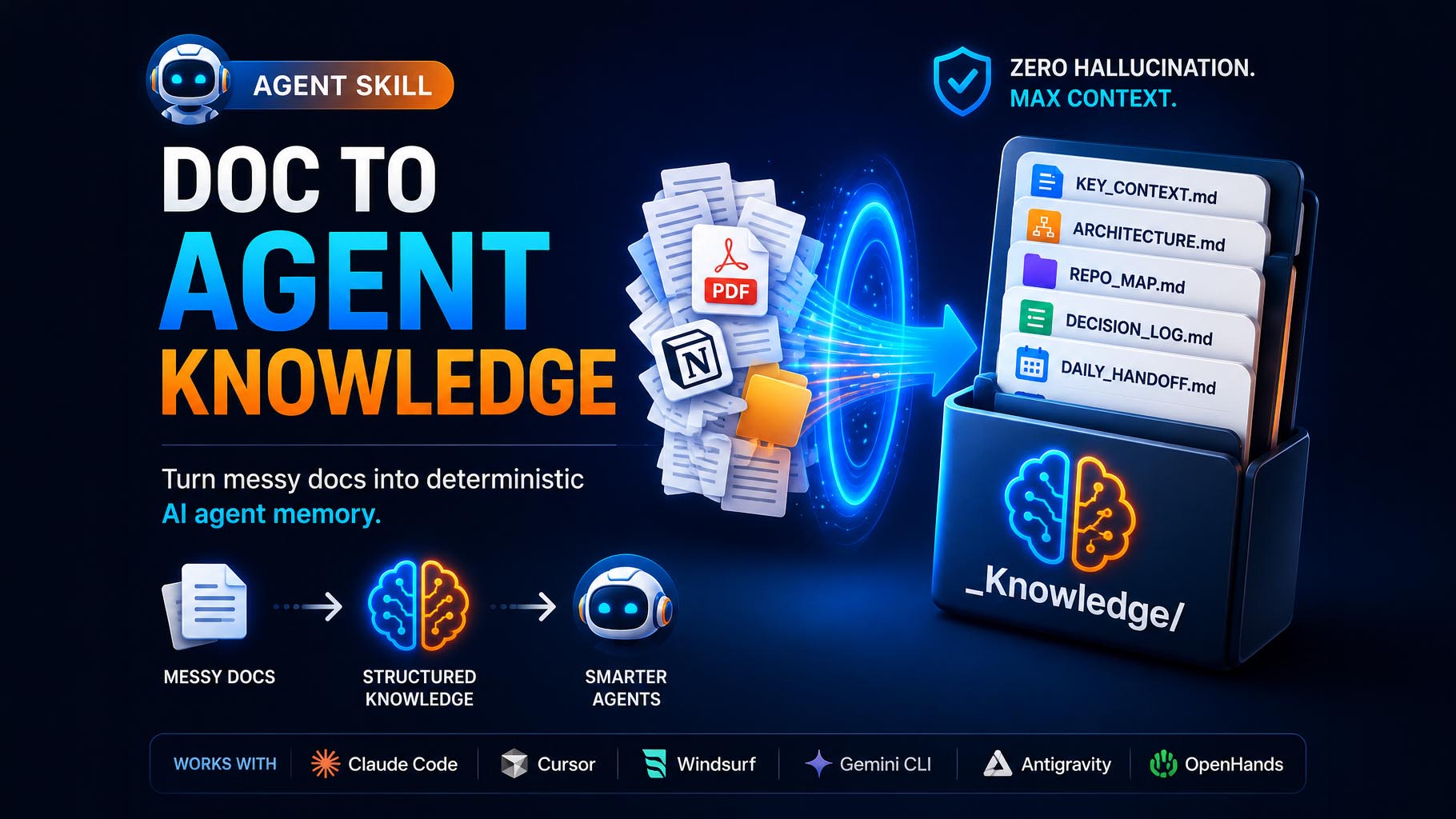
The Fix: structured agent knowledge layers. Instead of feeding an agent raw text, build a modular, high-density
_Knowledge/directory that loads into active context in a single pass.
2. The 5-File _Knowledge/ Architecture Blueprint
| File Name | Token Budget | Primary Cognitive Purpose |
|---|---|---|
| KEY_CONTEXT.md | < 1,200 tokens | 2-minute executive brief: mission, tech stack, and zero-tolerance negative rules. |
| ARCHITECTURE.md | < 1,500 tokens | Service boundaries, Mermaid data flows, and database entity relationships. |
| REPO_MAP.md | < 800 tokens | Directory tree with 1-line functional summaries for instant agent routing. |
| DECISION_LOG.md | < 1,000 tokens | Architectural Decision Records (ADRs) tracking rejected alternatives and rationale. |
| DAILY_HANDOFF.md | < 800 tokens | Session transfer logs preserving active state across agent reboots and handoffs. |
Full footprint across all five files: under 5,500 tokens total, leaving more than 95% of the context window open for actual code generation.
3. 3 Rules for Hallucination-Resistant Agent Memory
1. The Zero-Assumption Marker
When the source documentation leaves an environment variable, API credential, or business rule unspecified, tell the agent to write [UNSPECIFIED - REQUIRES CLARIFICATION] instead of inventing a placeholder value.
2. Deterministic Markdown Links
Every internal reference needs a standard, clickable relative markdown link, like [ARCHITECTURE.md](./ARCHITECTURE.md). That's what lets a coding agent walk the knowledge graph directly instead of running a grep search it didn't need to run.
3. Mandatory Context Checking via System Prompts
Put an invariant rule in your CLAUDE.md or .cursorrules file that forces the agent to check the knowledge layer before it touches any code:
# Agent Mandatory Context Rule
Before modifying any source code, you MUST inspect `_Knowledge/KEY_CONTEXT.md` to verify architectural boundaries and active negative constraints.
4. How to Use MCP Servers and the _Knowledge/ Layer with Claude Code
The Doc to Agent Knowledge Architect skill runs this entire setup for you. Point it at a chaotic Notion export or an existing repository, and in seconds it builds a production-grade _Knowledge/ layer, ready to wire into Claude Code's MCP servers or any comparable agent skills setup:
"Using the doc-to-agent-knowledge skill, analyze this project directory and construct a standardized _Knowledge/ architecture with KEY_CONTEXT.md, ARCHITECTURE.md, REPO_MAP.md, DECISION_LOG.md, and DAILY_HANDOFF.md."
Frequently Asked Questions
Why do AI coding agents hallucinate when given full documentation?
LLMs suffer from the "Lost in the Middle" phenomenon where technical constraints buried in long, prose-heavy paragraphs receive lower attention weights than structured, bulleted invariants.
How much token context does the _Knowledge/ architecture save?
It strips 60%+ documentation fluff, compressing 30,000-token messy repositories into a sub-5,500 token total system footprint.
Is this architecture compatible across Claude Code, Cursor, and Windsurf?
Yes. The _Knowledge/ standard uses universal GitHub-Flavored Markdown and deterministic relative links supported by all AI coding assistants.

Comments
Comments are reviewed before appearing publicly.
No comments yet — be the first.