Rewriting the Same Listing Four Times Wastes an Afternoon
An ai product description generator for ecommerce sellers earns its place the moment a product has to live on more than one channel. A wireless mouse with a 1000mAh battery does not need four separate writing sessions, it needs one spec sheet and four output formats. Most sellers either pay a copywriter per platform or write one generic description and paste it everywhere, which reads flat on Amazon and looks broken on a Shopify product page built for HTML and trust badges.
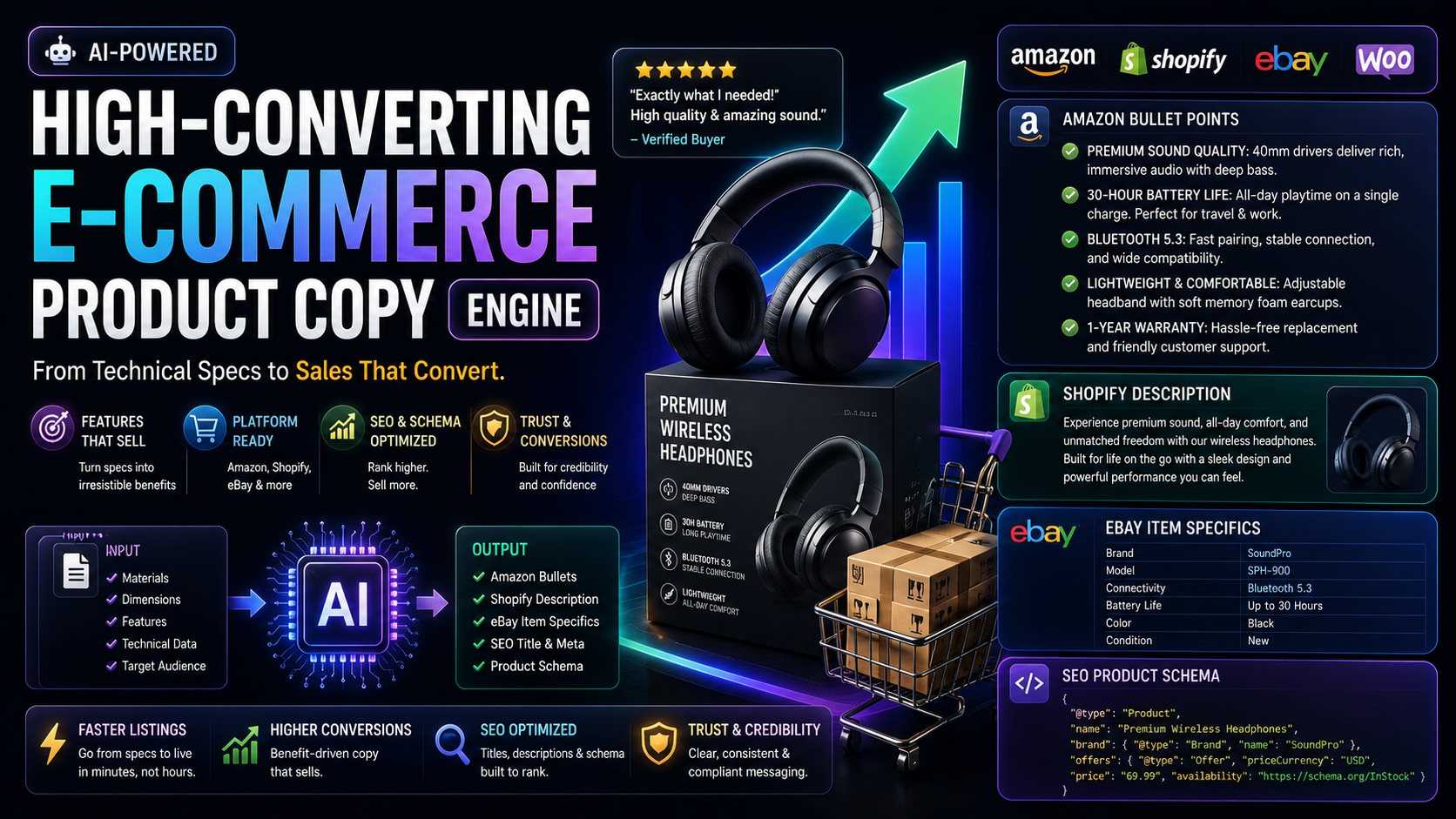
The High-Converting E-Commerce Product Copy Engine (ecommerce-product-copy-engine) runs a five-phase workflow that takes raw specs in and pushes formatted, platform-correct copy out: Amazon bullet points, Shopify/WooCommerce storytelling HTML, eBay item specifics, and structured Product schema. Nothing in the output is generic filler, each phase is scoped to what that specific platform's buyers and algorithms actually reward.
1. Ingest the Specs and the Target Buyer
Phase 1 takes in the raw material: dimensions, materials, color variants, and, separately, who the product is actually for. A power bank sold to backpackers and the same power bank sold to office commuters need different pain points surfaced first, even though the hardware spec sheet is identical. This phase also pulls out the competitive angle: what does this product do that the next-cheapest alternative on the same marketplace does not.
2. Translate Features into Benefits (the Matrix)
Phase 2 is where most spec sheets stop being useful for selling. A raw spec means nothing to a buyer scrolling on a phone; a benefit does. The engine runs every attribute through a feature-to-benefit translation:
| Raw Spec | Benefit-Driven Copy |
|---|---|
| Aircraft-grade aluminum alloy | Ultra-lightweight 140g build that survives accidental drops without bending |
| USB-C PD 65W fast charging | Goes from 0% to 80% charge in 25 minutes while you grab coffee |
| 1000mAh battery cell | Roughly 3 full days of outdoor use before the next charge |
| Precision-milled textured grip | Stays in hand during high-intensity outdoor activity, no slip |
Nothing here restates the spec. Each row answers "why does the buyer care," which is the sentence that actually sits inside the finished bullet, not the sentence that sits inside the spec sheet.
3. Generate the Amazon 5-Bullet Hierarchy
Phase 3 formats five bullets in a fixed structure: a capitalized 2-4 word hook, then a benefit-first sentence, mobile-optimized so it reads on a 6-inch screen without truncation. Warranty language is checked for internal consistency, no listing claims "lifetime" in bullet 2 and "2-year" in bullet 5.
- **ULTRA-LIGHTWEIGHT DURABILITY:** Engineered from aircraft-grade aluminum alloy, delivering rugged drop protection while weighing under 140g for effortless daily carry.
- **RAPID 65W POWER DELIVERY:** Charge your devices from 0 to 80% in just 25 minutes with smart USB-C PD technology, eliminating low-battery anxiety during travel.
- **ERGONOMIC ANTI-SLIP GRIP:** Precision-milled textured edges prevent accidental slips during high-intensity outdoor activities.
- **[PLACEHOLDER, NEEDS SUBSTANTIATION]:** A compatibility claim goes here only once the user confirms the actual tested devices (e.g. "compatible with iOS 15+/Android 11+, tested by manufacturer"), not "universal compatibility, zero driver setup" derived from the spec sheet alone.
- **2-YEAR COMPREHENSIVE WARRANTY:** Backed by our 24/7 customer support and full 2-year manufacturer replacement guarantee.
4. Write Shopify and WooCommerce Storytelling Copy
Phase 4 switches register entirely. Amazon rewards scannable bullets; a Shopify product page rewards a short hook, a specification table, trust badges, and an FAQ accordion that answers objections before checkout. WooCommerce archive pages get a shorter summary variant of the same copy, since archive cards have no room for a full story. This is the same underlying feature-to-benefit matrix from Phase 2, restructured for a slower, browsing-mode reader instead of a comparison-shopping one.
5. Generate eBay Specifics and JSON-LD Product Schema
Phase 5 produces two more artifacts from the same spec sheet: a clean eBay Item Specifics table, and schema.org Product markup ready to paste into a theme template.
<script type="application/ld+json">
{
  "@context": "https://schema.org/",
  "@type": "Product",
  "name": "Ultra-Slim 65W Power Bank",
  "description": "Aircraft-grade aluminum power bank with 65W fast USB-C delivery.",
  "brand": { "@type": "Brand", "name": "ApexGear" },
  "offers": {
    "@type": "Offer",
    "priceCurrency": "USD",
    "price": "49.99",
    "availability": "https://schema.org/InStock"
  }
}
</script>
A listing missing this markup is invisible to rich-result search features that show price and availability directly in search. Pasting it in takes one script tag; skipping it costs a seller that visibility for free.
Where the Four Formats Actually Diverge
| Platform | Format | Primary Constraint |
|---|---|---|
| Amazon | 5 capitalized-hook bullets | Mobile truncation, warranty consistency |
| Shopify | HTML story copy + spec table + FAQ | Trust signals, browsing-mode pacing |
| WooCommerce | Short archive summary + attributes | Card-size character limits |
| eBay | Item specifics table + responsive description | Structured field-by-field matching |
Treating all four as "one description, pasted four times" is exactly the gap this engine closes. The spec sheet does not change between platforms; the reader's mode of attention does. This is the practical difference between a generic rewrite tool and an ai product description generator for ecommerce built around platform-specific rules.
Frequently Asked Questions
Does this replace a human copywriter for e-commerce listings?
It replaces the repetitive part — reformatting the same product for four different platforms — and produces a first draft with the feature-to-benefit logic already applied. A seller still reviews claims before publishing, particularly warranty and compliance language.
How does it keep Amazon bullets from making contradictory claims?
Core Rule #2 checks warranty and durability language across all five bullets for internal consistency, so a listing does not simultaneously promise "lifetime" coverage in one bullet and "2-year" coverage in another.
Can it generate copy for a product with no existing marketing material?
Yes. The only required input is the raw spec sheet — dimensions, materials, and functional details — plus a target buyer description. Phase 1 works from technical specs alone; it does not need existing ad copy to start from.

Comments
Comments are reviewed before appearing publicly.
No comments yet — be the first.