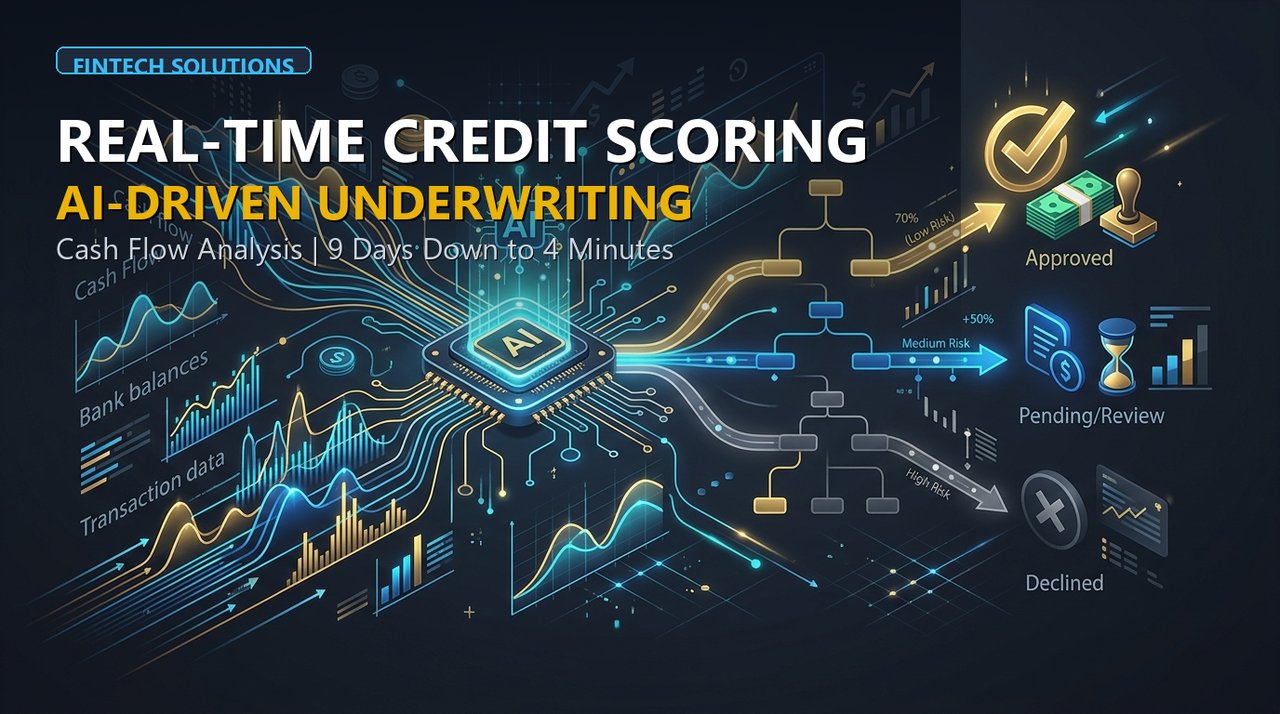
Traditional commercial loan underwriting is painfully slow. Last year, Amir and I consulted for a regional lending partner in Southeast Asia. Their average turnaround time to approve a small business micro-loan was nine business days. Loan officers manually reviewed PDF bank statements, cross-checked tax declarations in Excel, and verified business registries by hand.
By the time loan approval arrived, 35% of applicants had abandoned the process or borrowed elsewhere.
We spent six weeks building an automated underwriting pipeline. We combined optical character recognition (OCR), transaction categorization embeddings, and gradient-boosted decision trees wrapped in a Python orchestration service. Turnaround time dropped from nine days to four minutes, while maintaining default rate variance under 1.4%.
Here is the technical architecture behind building an automated, compliant credit risk scoring engine.
The Real-Time Underwriting Pipeline
Automated underwriting cannot be a black-box LLM call. Banking regulators strictly forbid uninterpretable credit denials (e.g. Fair Credit Reporting Act adverse action notices require verifiable, human-readable explanations).
Our architecture splits the evaluation into deterministic feature extraction and statistical scoring:
Applicant Bank Statements (PDFs / Plaid API)
                  │
                  ▼
Raw Transaction Extraction & Normalization
                  │
                  ▼
Cash Flow Feature Engineering (Debt Service Coverage, Net Inflows, Volatility)
                  │
                  ▼
XGBoost Credit Risk Scorer (Probability of Default: PD)
                  │
                  ▼
LLM Adverse Action Reason Generator (Explainable regulatory notices)
                  │
                  ▼
Instant Loan Decision: [ APPROVE / REJECT / MANUAL ESCALATION ]
Cash Flow Feature Engineering in Python
Creditworthiness in small business lending is determined by real-time cash flow volatility, not static FICO scores. Here is the feature extraction service we built using pandas and numpy:
# cash_flow_features.py
import pandas as pd
import numpy as np
from dataclasses import dataclass
from typing import Dict, Any

@dataclass
class CashFlowMetrics:
    monthly_recurring_inflow: float
    operating_expense_ratio: float
    dscr: float  # Debt Service Coverage Ratio
    cash_buffer_days: float
    overdraft_count_90d: int
    net_burn_rate: float

def compute_underwriting_features(transactions_df: pd.DataFrame, requested_monthly_debt: float) -> Dict[str, Any]:
    """Computes credit risk features from 180 days of transaction history."""
    transactions_df["date"] = pd.to_datetime(transactions_df["date"])
    recent_90d = transactions_df[transactions_df["date"] >= (pd.Timestamp.now() - pd.Timedelta(days=90))]

    inflows = transactions_df[transactions_df["amount"] > 0]["amount"].sum()
    outflows = abs(transactions_df[transactions_df["amount"] < 0]["amount"].sum())

    # Calculate monthly averages over 6 months
    avg_monthly_inflow = inflows / 6.0
    avg_monthly_outflow = outflows / 6.0
    net_operating_income = avg_monthly_inflow - avg_monthly_outflow

    # Debt Service Coverage Ratio (DSCR)
    dscr = net_operating_income / requested_monthly_debt if requested_monthly_debt > 0 else 999.0

    # Daily cash buffer calculation
    daily_balances = transactions_df.groupby("date")["running_balance"].last()
    avg_daily_burn = avg_monthly_outflow / 30.0
    latest_balance = daily_balances.iloc[-1] if not daily_balances.empty else 0.0
    cash_buffer_days = latest_balance / avg_daily_burn if avg_daily_burn > 0 else 0.0

    # Overdraft frequency in past 90 days
    overdrafts_90d = int((recent_90d["running_balance"] < 0).sum())

    return {
        "avg_monthly_inflow": round(avg_monthly_inflow, 2),
        "dscr": round(dscr, 2),
        "cash_buffer_days": round(cash_buffer_days, 1),
        "overdrafts_90d": overdrafts_90d,
        "net_operating_income": round(net_operating_income, 2)
    }
Decision Matrix and Probability of Default
The extracted features feed into a trained XGBoost classifier that outputs a calibrated Probability of Default (PD). The business policy engine then maps the PD to loan limits:
| Risk Tier | Probability of Default (PD) | DSCR Requirement | Maximum Loan Limit | Action |
|---|---|---|---|---|
| Tier 1 (Prime) | < 1.5% | > 2.0x | $150,000 | Instant Automated Approval |
| Tier 2 (Near-Prime) | 1.5% - 4.5% | 1.35x - 2.0x | $50,000 | Instant Automated Approval |
| Tier 3 (Subprime) | 4.5% - 8.0% | 1.15x - 1.35x | $15,000 | Conditional Approval (Requires Collateral) |
| Tier 4 (High Risk) | > 8.0% | < 1.15x | $0 | Instant Decline with Adverse Action Notice |
Generating Compliant Adverse Action Notices with LLMs
Under financial regulations (like ECOA and FCRA), you cannot just say "Score too low". You must provide specific, principal reasons for denial.
We use Claude with strict JSON validation to inspect the feature anomalies and draft legally defensible explanations:
# adverse_action_generator.py
import json
from anthropic import Anthropic

client = Anthropic()

def generate_adverse_action_reasons(metrics: dict, applicant_name: str) -> dict:
    prompt = f"""
    The loan application for {applicant_name} was rejected.
    Extracted financial features:
    - Debt Service Coverage Ratio (DSCR): {metrics['dscr']} (Minimum required: 1.35)
    - Cash Buffer Days: {metrics['cash_buffer_days']} days (Minimum required: 14 days)
    - Overdraft count in 90 days: {metrics['overdrafts_90d']} (Maximum allowed: 1)

    Generate 2 to 3 principal legal reasons for credit denial under FCRA guidelines.
    Return strictly JSON matching this structure:
    {{
        "adverse_action_reasons": ["string"],
        "recommended_remediation": ["string"]
    }}
    """

    response = client.messages.create(
        model="claude-sonnet-5",
        max_tokens=1000,
        messages=[{"role": "user", "content": prompt}]
    )

    return json.loads(response.content[0].text)
Sample Output:
{
  "adverse_action_reasons": [
    "Insufficient debt service coverage ratio based on verified net monthly operating income.",
    "Excessive overdraft events detected in deposit account within the preceding 90 days."
  ],
  "recommended_remediation": [
    "Re-apply after maintaining a positive daily balance for 90 consecutive days.",
    "Lower requested loan amount to align with current debt service thresholds."
  ]
}
Security & Fraud Safeguards
When automating credit issuance, fraudsters will attempt to submit forged bank statement PDFs. We enforce these verification layers:
- PDF Metadata Inspection: Flag documents created with graphic editors like Photoshop or Canva.
- Transaction ETag Hashing: Detect duplicated statement uploads across different applicant identities.
- Plumbing into Open Banking: Whenever possible, bypass uploaded PDFs entirely and pull real-time read-only ledger feeds via Plaid, Yodlee, or Mono.
Automating underwriting does not mean sacrificing risk discipline. By pairing deterministic financial feature calculations with statistical risk models and explainable AI notices, fintech lenders can scale origination volume while keeping loss ratios strictly controlled.




Comments
Comments are reviewed before appearing publicly.
No comments yet — be the first.