Why a Privacy Policy Template Is the Wrong Starting Point
Most teams find their privacy policy the same way: search "GDPR privacy policy template," swap in the company name, publish. It reads fine. It's also usually wrong, because it was written for nobody's actual codebase.
Say a SaaS product added Stripe for billing, PostHog for product analytics, and a phone_number column to the users table two sprints ago. The templated policy still says "we may collect certain information" in the passive voice a lawyer used for a hypothetical client in 2021. It doesn't name PostHog. It doesn't say the phone number gets stored, or for how long, or under what legal basis. If a user files a GDPR data subject access request, the person answering it has to go find that information anyway, the policy didn't save any work, it just created a document that doesn't match reality.
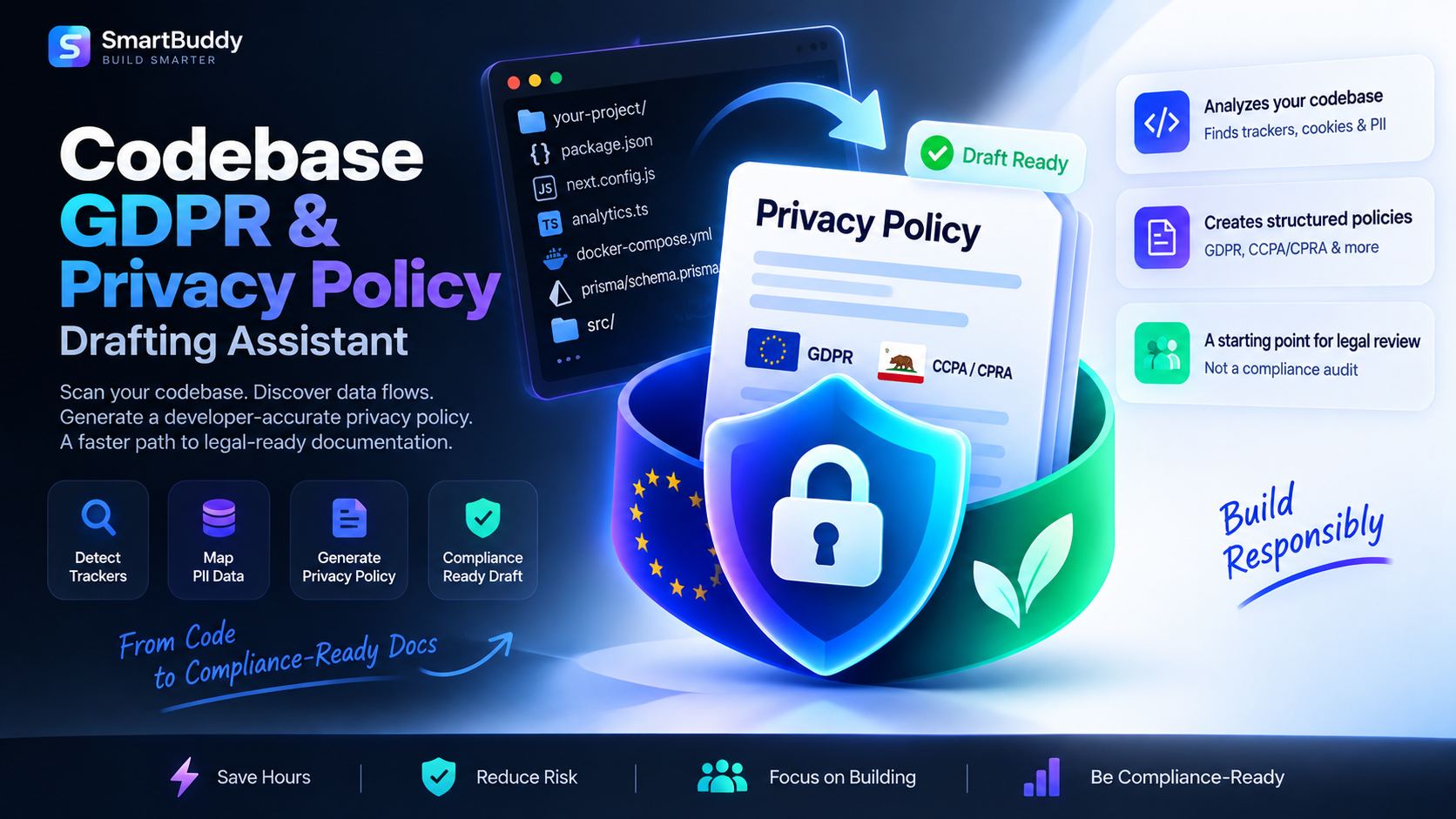
The Codebase GDPR & Privacy Policy Drafting Assistant skill flips the order: it reads the code first, then writes the policy from what it finds.
Phase 1: Scanning for the Trackers Nobody Remembers Adding
The first pass goes through package.json, requirements.txt, script tags, and analytics initialization hooks looking for three categories of third-party integration:
- Analytics & telemetry, Google Analytics, PostHog, Mixpanel, Sentry, Hotjar
- Payment & authentication, Stripe, PayPal, Auth0, Clerk, Supabase
- Marketing & advertising, Meta Pixel, TikTok Pixel, LinkedIn Insight Tag
This is usually the phase that surprises people. A growth intern adds a TikTok Pixel snippet for a single campaign in March, the campaign ends in April, and the pixel is still firing on every page load in September because nobody circled back to remove it. A codebase scan catches it; a memory of "what we integrated" doesn't.
Phase 2: Building the Cookie and PII Inventory
Once the SDK scan is done, the skill maps every collected data category against your actual database schema and cookie storage, not a guess at what a typical SaaS collects, but what this one does. Two of those columns need an honest caveat, though: a codebase can't prove a legal basis or a retention period on its own, so the skill labels both as inferences to confirm, not settled facts:
| Service / Cookie | Purpose | Data Collected | Candidate Legal Basis, confirm with legal | Retention Period |
|---|---|---|---|---|
sb_session |
Session Authentication | User ID, Encrypted Token | Likely Contractual Necessity / Legitimate Interest | Observed: 30 days (session cookie maxAge in code) |
| PostHog Analytics | Product Improvement | Pageviews, Anonymized IP | Likely Consent (Opt-in) | Declared: 12 months (per PostHog project setting, not verifiable from this codebase alone) |
| Stripe Billing | Payment Processing | Card details (hosted), Email | Likely Contractual Necessity | Not determinable from codebase (tax-law retention requirements aren't visible in application code) |
Notice the third column isn't "personal data" as a catch-all, it's the specific fields. The legal basis and retention columns aren't a single value copy-pasted down the table either, but they're also not presented as verdicts: "likely" and "candidate" do real work in that header. Whether a session cookie's actual basis is contractual necessity or legitimate interest, and whether Stripe's real retention window is five years or seven, depends on facts a codebase can't see, the actual processing context, the jurisdiction, the agreements in place. What the scan can prove, that PostHog is present, that a session cookie exists with a 30-day maxAge, that a card details field is hosted rather than stored locally, it states as fact. What it can only infer, it labels as an inference. That distinction is exactly the part a generic template, and a less careful auditor, glosses over.
Phase 3: Generating the Policy Itself
With the audit data in hand, the skill drafts the actual policy document, Markdown or HTML, structured around five required sections:
"Using the privacy-policy-gdpr-generator skill, audit our Next.js
repository for third-party SDKs and cookies, and generate a
transparent GDPR and CCPA Privacy Policy."
Running that prompt against a real repo produces:
- Controller information & contact, GDPR Article 13 requires the controller's actual identity, a legal/business name and a real address, not an email address standing in for it. The skill asks for this rather than shipping a placeholder.
- Specific data collection & purpose, audited directly from the codebase in Phase 1 and 2
- Third-party sub-processors directory, every vendor found in the scan, listed by name
- User rights, listed per jurisdiction, not merged into one list, GDPR's access, rectification, erasure ("right to be forgotten"), data portability, right to object, and right to restrict processing are a different rights framework from CCPA/CPRA's right to know, right to delete, right to correct, right to opt-out of sale/sharing (which needs an actual "Do Not Sell or Share My Personal Information" mechanism, not just a mention), right to limit use of sensitive personal information, and right to equal treatment. Collapsing both into a single shared checklist is exactly the kind of shortcut that makes a generated policy legally sloppy.
- Cookie consent & opt-out directives, including implementation notes for a frontend consent banner with opt-in/opt-out toggles
Every generated document also carries a standard developer compliance disclaimer stating the policy reflects a code-level audit and should get a final legal review for the jurisdictions the business actually operates in. The skill drafts an accurate first pass; it doesn't replace counsel.
What Makes This Different From a Cookie Banner Plugin
A cookie consent plugin manages the banner UI. It doesn't know whether the "analytics" cookie it's asking permission for is Google Analytics or PostHog, and it definitely doesn't know that the users table has a date_of_birth field that falls under special category data in some jurisdictions. This skill operates one layer earlier, it produces the inventory and the policy text that a consent tool then enforces, and it does so by reading the source of truth: the code itself, not a form somebody filled out from memory during onboarding.
That code-grounded accuracy is the entire premise. If a tracker isn't in the codebase, it doesn't appear in the policy. If it is, it gets listed with its actual purpose and data collected, plus whatever the code can actually prove about retention, labeled honestly as observed, configured, declared, or simply not determinable, rather than a plausible-sounding number invented to fill the cell. That's a discipline a manually written policy almost never keeps for more than a few months before something changes.
Frequently Asked Questions
How does it audit privacy from code instead of just asking questions?
It inspects package dependencies, analytics integrations like PostHog and Google Analytics, database schemas storing PII (emails, IPs, names), and cookie storage directives directly, rather than relying on a developer's memory of what was integrated.
Which privacy regulations does it cover?
European Union GDPR and California CCPA/CPRA, drafted as two separate rights frameworks rather than one merged list. Worth being direct about scope: current CCPA/CPRA compliance also involves risk assessments, cybersecurity audits, and automated decision-making technology (ADMT) disclosures that no codebase scan can evaluate. This skill drafts the parts a codebase can actually speak to, the tracker inventory, the data fields, the cookie table, not a full compliance certification.
Does the generated policy replace a lawyer's review?
No. Every output includes a standard developer transparency disclaimer stating the policy is based on a code-level audit and recommends final legal review for the business's specific jurisdictions.

Comments
Comments are reviewed before appearing publicly.
No comments yet — be the first.