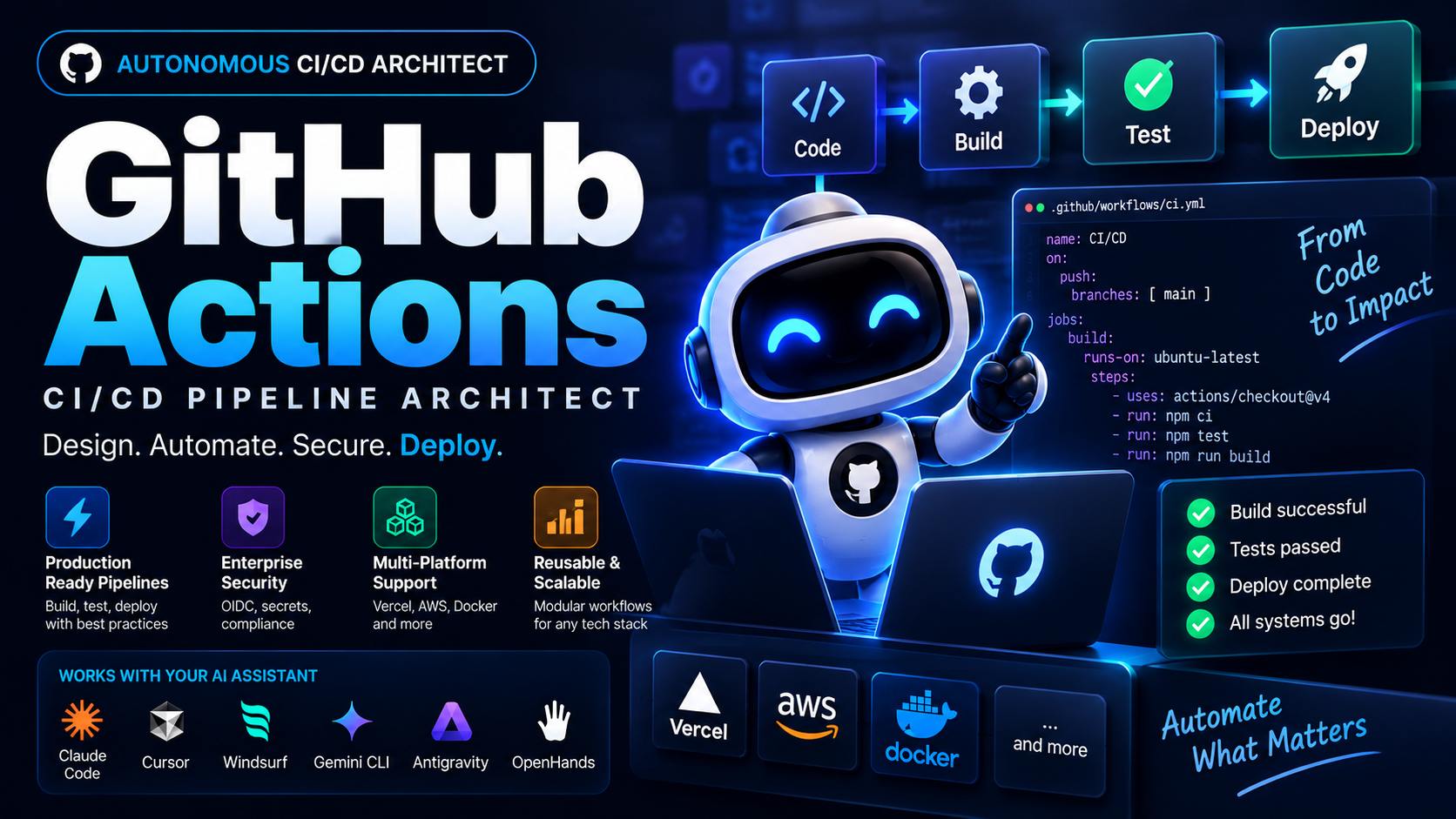
An AI agent for GitHub Actions CI/CD pipelines doesn't just autocomplete YAML syntax, it applies the same caching, matrix-testing, and OIDC-deployment patterns a senior DevOps engineer would, on the first draft, for whichever stack you point it at.
Why Hand-Written GitHub Actions YAML Keeps Breaking
Most teams start their .github/workflows/ci.yml by copying one from a different repo, then edit it until the red X turns green. That file usually skips three things nobody notices until it costs them: a permissions block (so the job runs with the full default GITHUB_TOKEN scope), a concurrency group (so five commits pushed in two minutes queue five redundant full test runs), and dependency caching (so npm install re-downloads the same 400MB node_modules on every single push).
None of that is exotic. It's just tedious to write correctly by hand every time a new repo needs a pipeline, and it's the kind of thing an AI coding agent can generate once you tell it what stack you're on.
The Real Cost of a Missing Concurrency Group: Six pushes to a PR branch in ten minutes without
cancel-in-progressmeans six full matrix test runs queue up instead of one, on a 2-OS by 2-Node matrix, that's 24 redundant jobs burning CI minutes for a change nobody will look at until run six finishes.
What This AI Agent for GitHub Actions CI/CD Pipelines Generates
The GitHub Actions CI/CD Pipeline Architect is a $16 Claude Code / Cursor / Windsurf agent skill that runs a six-phase workflow: it ingests your stack (Node/Next.js, Python/FastAPI, Go, Docker) and your deployment target (Vercel, AWS ECS, Cloudflare Workers, Fly.io), then generates a CI test-and-lint workflow, a hardened OIDC production-deploy workflow, a Docker build-and-cache workflow, a permissions audit pass across all of them, and a validation pass that actually checks the output instead of assuming the generation step got everything right.
1. Matrix Testing and Dependency Caching
Instead of a single Node version and a cold npm install every run, the skill scaffolds a matrix job with actions/cache wired through the package-manager-aware cache: field. Four details below aren't fixed defaults, they're read from the actual repo: the package manager (pnpm shown, but detected from whichever lockfile is actually present, pnpm-lock.yaml, yarn.lock, package-lock.json, or either bun.lock or the older bun.lockb), the Node versions in the matrix (read from engines/.nvmrc, not a generic [18.x, 20.x] pair), the script names (lint/typecheck/test:coverage shown, but taken from package.json's actual scripts block), and every third-party action, pinned to a full commit SHA rather than a mutable tag like @v4, a tag can be silently repointed to malicious code by a compromised maintainer account, which is exactly how the real tj-actions/changed-files supply-chain incident happened; a SHA can't be:
# .github/workflows/ci.yml
name: CI Pipeline

on:
  push:
    branches: [main, develop]
  pull_request:
    branches: [main]
  workflow_dispatch: {}

permissions:
  contents: read

concurrency:
  group: ${{ github.workflow }}-${{ github.ref }}
  cancel-in-progress: true

jobs:
  lint-and-test:
    name: Lint, Typecheck & Test
    runs-on: ubuntu-latest
    strategy:
      matrix:
        node-version: [18.x, 20.x]   # replace with the versions the repo's engines/.nvmrc actually declare
    steps:
      - name: Checkout Code
        uses: actions/checkout@<resolved-commit-sha> # v4.x, look up the current release, don't reuse an old SHA

      - name: Setup pnpm
        uses: pnpm/action-setup@<resolved-commit-sha> # swap for the repo's actual package manager's setup action
        with:
          version: 9   # read from packageManager/devEngines.packageManager in package.json

      - name: Setup Node.js ${{ matrix.node-version }}
        uses: actions/setup-node@<resolved-commit-sha> # v4.x, look up the current release
        with:
          node-version: ${{ matrix.node-version }}
          cache: 'pnpm'

      - name: Install Dependencies
        run: pnpm install --frozen-lockfile

      - name: Run Lint
        run: pnpm lint   # substitute the actual script name from package.json

      - name: Run Type Check
        run: pnpm typecheck   # substitute the actual script name

      - name: Execute Test Suite with Coverage
        run: pnpm test:coverage   # substitute the actual script name and test runner
Two Node versions running in parallel, whichever ones the project actually declares support for, not a generic default pair, each pulling from a warm cache instead of a cold install, and the whole group cancels itself the moment a newer commit lands on the same branch. Also notice the permissions: contents: read block up top, most hand-written and template CI workflows skip this on the test job entirely, reasoning that least-privilege only matters for the deployment workflow that touches cloud credentials. It applies here too: a CI job with no permissions block inherits the repo's default token scope, which is broader than "read the code and run tests" needs to be.
2. Keyless OIDC Cloud Deployment
This is the part most teams skip because it's fiddly to set up by hand: instead of storing an AWS access key and secret in GitHub Secrets forever, the workflow requests a short-lived OIDC token and trades it for temporary cloud credentials at run time.
# .github/workflows/deploy-production.yml
name: Production Deployment

on:
  push:
    tags:
      - 'v*.*.*'
  workflow_dispatch: {}

permissions:
  id-token: write   # Required for requesting the AWS OIDC JWT
  contents: read

jobs:
  deploy:
    name: Cloud Deployment
    runs-on: ubuntu-latest
    environment: production   # gated by required reviewers in repo settings
    steps:
      - name: Checkout
        uses: actions/checkout@<resolved-commit-sha> # v4.x

      - name: Configure AWS Credentials (OIDC)
        uses: aws-actions/configure-aws-credentials@<resolved-commit-sha> # v4.x
        with:
          role-to-assume: arn:aws:iam::<account-id>:role/<deployment-role> # confirm the real ARN before this ships
          aws-region: <aws-region> # confirm the real region before this ships

      - name: Deploy Infrastructure / Container
        run: |
          echo "Deploying release ${{ github.ref_name }} via keyless OIDC..."
No static AWS_SECRET_ACCESS_KEY sitting in your repo settings, waiting to be leaked in a fork's pull request logs. The trigger is a real semver tag (v*.*.*, a literal v[0-9].[0-9].[0-9] only matches single-digit segments and quietly stops firing once a project reaches v10.0.0), not every push to main, so a production deploy only fires when you cut a release.
The workflow file is half the story, though. The actual security boundary is the AWS IAM role's trust policy, it needs a Condition restricting the OIDC token's sub claim to this specific repo, branch, and GitHub Environment. Skip that and the workflow's id-token: write permission is fine, but the role itself is assumable by anyone who finds the ARN, from any repo. The skill generates that trust policy JSON alongside the workflow, not as a separate afterthought, and recommends the production Environment above be gated with required reviewers, since id-token: write authenticates the job, it doesn't gate whether the job runs in the first place.
GitHub Actions Permissions: Default vs. What This Skill Generates
The single biggest gap between a tutorial-copied workflow and a production one is the permissions block. Left unset, a workflow job inherits whatever default token scope the repository owner configured, often read/write on everything.
| Configuration | Default GITHUB_TOKEN Behavior | What the Architect Skill Generates |
|---|---|---|
| Permissions scope | Repository-wide default (often read/write) | Explicit least-privilege block per job (e.g. `contents: read`, `id-token: write` only where needed) |
| Concurrent runs | Every push queues a new run | `concurrency` group with `cancel-in-progress: true` |
| Third-party Actions | Often pinned to `@main` or unpinned | Pinned to a full commit SHA, a major-version tag like `@v4` is mutable and has been the actual attack vector in real supply-chain incidents |
| Cloud auth | Long-lived static secrets | Keyless OIDC token exchange |
| Docker builds | No layer cache, full rebuild each run | `docker/build-push-action` with GitHub Actions cache backend (`type=gha`) |
The Validation Pass: Checking the Output, Not Just Generating It
A generated workflow is only as good as what actually got written into it, and a placeholder that never got resolved is a bug, not a draft. The last phase checks four things before handing the files back: that the YAML actually parses, that every action reference has a real, current commit SHA in place of a placeholder, that every run: command points at a script that exists in the project's own package.json or Makefile, and that the OIDC trust policy's sub condition actually matches the repo, branch, and Environment the workflow deploys from. Skipping that last check is a common way an OIDC setup looks correct in the YAML and then fails at the AWS authentication step the first time it actually runs.
Running the Skill on Your Own Stack
The skill installs the same way any Claude Code / Cursor / Windsurf / Gemini CLI / Antigravity / OpenHands skill does, drop SKILL.md into your agent's skills directory and call it by name in a prompt:
"Using the github-actions-ci-cd-architect skill, generate a complete GitHub Actions CI/CD workflow for our Next.js 15 app with pnpm caching, Vitest matrix testing, and Vercel production deployment."
For a container-based stack, the same skill handles the Docker side:
"Using the github-actions-ci-cd-architect skill, write an automated Docker container build and push workflow to Amazon ECR using GitHub Actions GHA caching and OIDC authentication."
It doesn't need network access to do this, all processing runs inside your local agent session, reading and generating files in your workspace.
Why an AI Agent for GitHub Actions CI/CD Pipelines Earns Its Keep
Building an AI agent for GitHub Actions CI/CD pipelines isn't about replacing the judgment call of which cloud target or test runner to use, that's still yours. It's about not re-deriving the same permissions block, concurrency group, and cache configuration from scratch on the fifteenth repo this quarter. Point the skill at your stack, get a matrix-tested, OIDC-authenticated, cache-warmed workflow file, and spend the saved hour on the part of the pipeline that's actually specific to your app.
Frequently Asked Questions
Does this skill store cloud credentials anywhere?
No. It generates keyless OIDC authentication workflows for AWS, so no permanent access key ever needs to sit in GitHub Secrets.
What deployment targets does the generated YAML support?
The skill scaffolds workflows for Vercel, AWS ECS, Cloudflare Workers, and Fly.io, plus generic Docker image builds pushed to GitHub Container Registry or Amazon ECR.
Which AI coding assistants can run this skill?
Claude Code, Cursor, Windsurf, Gemini CLI, Google Antigravity, and OpenHands, it installs as a standard SKILL.md file in each tool's skills directory.

Comments
Comments are reviewed before appearing publicly.
No comments yet — be the first.