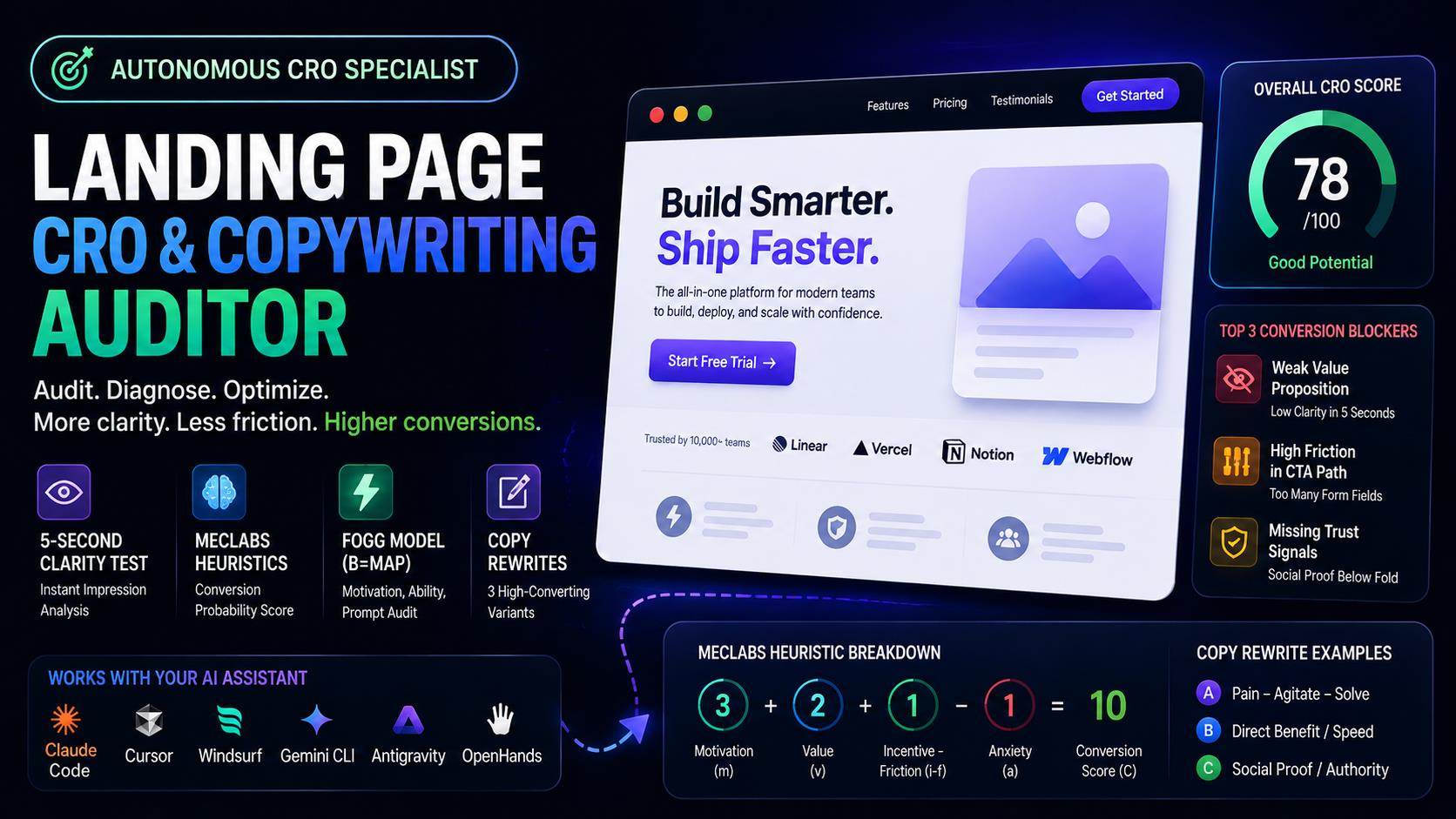
1. Why You Need an AI Landing Page Conversion Audit
A landing page can load in 400ms, look polished, and still convert at 1.2% because the failure isn't technical. It's a five-second window where a visitor decides whether the page understood their problem. Miss that window with a headline that talks about your product instead of their pain, and the bounce happens before anyone scrolls to the CTA.
Manual CRO reviews catch some of this. What they usually miss is consistency: a reviewer might flag a weak headline on Monday and ignore an identical pattern in the pricing section on Friday. An AI landing page conversion audit applies the same scoring formula to every section in one pass, so the hero, the features block, and the testimonials all get graded against the same bar.
That's the job of the landing-page-cro-auditor skill, a $14 Claude Code / Cursor / Windsurf / Gemini CLI / Antigravity / OpenHands skill built specifically to ingest a landing page's HTML, JSX, or raw copy and run it through two behavioral psychology frameworks before handing back a scorecard.
2. How an AI Landing Page Conversion Audit Scores Your Copy: MECLABS Explained
The core scoring formula is:
C = 4m + 3v + 2(i - f) - 2a
| Variable | Meaning | Weight | Audit Question |
|---|---|---|---|
| m, Motivation | Does the headline match a pre-existing pain point? | ×4 (heaviest) | Would the visitor's inner monologue say "yes, that's my problem"? |
| v, Value Clarity | Is the unique advantage obvious inside the 5-second window? | ×3 | Could someone explain what you sell after reading only the H1? |
| i − f, Incentive minus Friction | Are form fields minimized and is value offered immediately? | ×2 | Does signup ask for a credit card before proving anything? |
| a, Anxiety | Are trust badges, privacy terms, and guarantees visible? | −2 (penalty) | Is there anything reassuring near the CTA, or just a button? |
The weighting matters more than the label. A page with a gorgeous trust-badge row (low a) but a generic headline (low m) still scores badly, because motivation carries double the weight of anxiety reduction. Most manual reviews get this backwards, they polish trust signals last, when the formula says fix the headline first.
3. Fogg Behavior Model: Why a Great Headline Still Fails to Convert
Motivation alone doesn't produce a click. The Fogg Behavior Model states behavior only happens when B = MAP, Motivation, Ability, and Prompt converge at the same moment:
- M (Motivation): The page must reinforce the transformation with a concrete metric or customer outcome, not an adjective.
- A (Ability): Every extra form field or mandatory credit card is a tax on Ability. Swapping a 10-field demo form for 1-click Google/GitHub auth raises conversion by lowering the cost of acting.
- P (Prompt): The button copy itself. "Submit" and "Learn More" give the visitor zero information about what happens next; "Deploy First Agent in 2 Mins →" and "Start Free 14-Day Trial →" state the exact value delivered on click.
This is the phase where most landing pages fail silently, the copy is emotionally compelling, the form is short, but the button undoes both by being generic.
| Weak Prompt (Low Ability Signal) | High-Motivation Trigger (Fogg-Aligned) |
|---|---|
| Submit | Deploy First Agent in 2 Mins → |
| Learn More | See the CRO Scorecard in 60 Seconds → |
| Get Started | Start Free 14-Day Trial → |
| Sign Up | Claim Your Audit Report → |
4. The 5-Phase Audit Workflow
Running the skill triggers a fixed sequence, this is the actual phase structure defined in the skill's SKILL.md, not a generic checklist:
- Ingestion & Audience Audit, parses the page HTML, JSX/TSX component, or raw copy, and identifies the target persona, core value proposition, and primary conversion goal (SaaS signup, demo booking, skill purchase).
- 5-Second Clarity Test & MECLABS Scoring, runs the
C = 4m + 3v + 2(i-f) - 2aformula against each section. - Fogg Behavior Model Inspection, checks Motivation, Ability, and Prompt independently, flagging where any one of the three is missing.
- Copy Refactoring, generates three formulaic rewrite variants for every weak section: Pain-Agitate-Solve, Direct Benefit/Speed, and Social Proof/Category Dominance.
- CRO Scorecard & Implementation Plan, outputs an overall score (0–100), a MECLABS diagnostic breakdown, the top 3 conversion blockers, and drop-in copy patches for the hero, features, testimonials, and pricing sections.
5. Running It: A Real Prompt and What Comes Back
Install by copying the skill folder into your assistant's skills directory:
# Claude Code
mkdir -p .claude/skills/landing-page-cro-auditor
cp SKILL.md .claude/skills/landing-page-cro-auditor/
Then trigger it against an actual component, not an abstract description:
"Using the landing-page-cro-auditor skill, audit our Hero.tsx component using
MECLABS and FBM heuristics. Diagnose clarity bottlenecks and provide 3
high-converting headline and CTA rewrites."
A typical Ability fix the audit produces looks like this, replacing a vague, un-styled submit button with a Fogg-aligned prompt that states the outcome and removes ambiguity about what happens next:
// Before, Prompt gives no value signal, Ability cost unclear
<button onClick={handleSubmit}>Submit</button>

// After, Fogg-aligned Prompt (P), Motivation (M) stated in copy,
// Ability (A) friction acknowledged via "no card required"
<button
  type="button"
  onClick={handleSubmit}
  aria-label="Start free 14-day trial, no credit card required"
  className="cta-primary"
>
  Start Free 14-Day Trial →
  <span className="cta-subtext">No credit card required</span>
</button>
The skill's core rules keep this from drifting into empty marketing-speak: clarity over cleverness (no poetic copy replacing a clear explanation), every primary button must state the exact value delivered on click, and every proof section needs a verifiable number, not a vague superlative.
Frequently Asked Questions
What frameworks does the landing page CRO auditor actually implement?
It runs the 5-Second Clarity Test, the Fogg Behavior Model (Motivation, Ability, Prompt), and the MECLABS Conversion Heuristic formula C = 4m + 3v + 2(i-f) - 2a, where C is the probability of conversion.
Can it audit a React component, or only static HTML?
Both, plus raw markdown copy. It parses HTML, JSX/TSX, and analyzes headline clarity, visual hierarchy, and CTA placement across whichever format you feed it.
Does it just diagnose problems, or does it write the replacement copy too?
It writes replacement copy. For every weak section it identifies, it outputs three variant rewrites — Pain-Agitate-Solve, Direct Benefit, and Social Proof — giving you concrete alternatives to A/B test instead of a diagnosis you'd still have to solve yourself.
Comments
Comments are reviewed before appearing publicly.
No comments yet — be the first.