Why a Generic Resume Fails an ATS Screen
A resume written for a human reader and a resume written for an Applicant Tracking System are not the same document. Most ATS platforms, Workday, Greenhouse, Lever, parse text and score it against the required terms pulled from the job description before a recruiter ever opens the file. A bullet like "Responsible for fixing database performance issues and updating queries" contains no parseable keyword match and no quantified outcome, so it scores low twice over: once on relevance, once on impact.
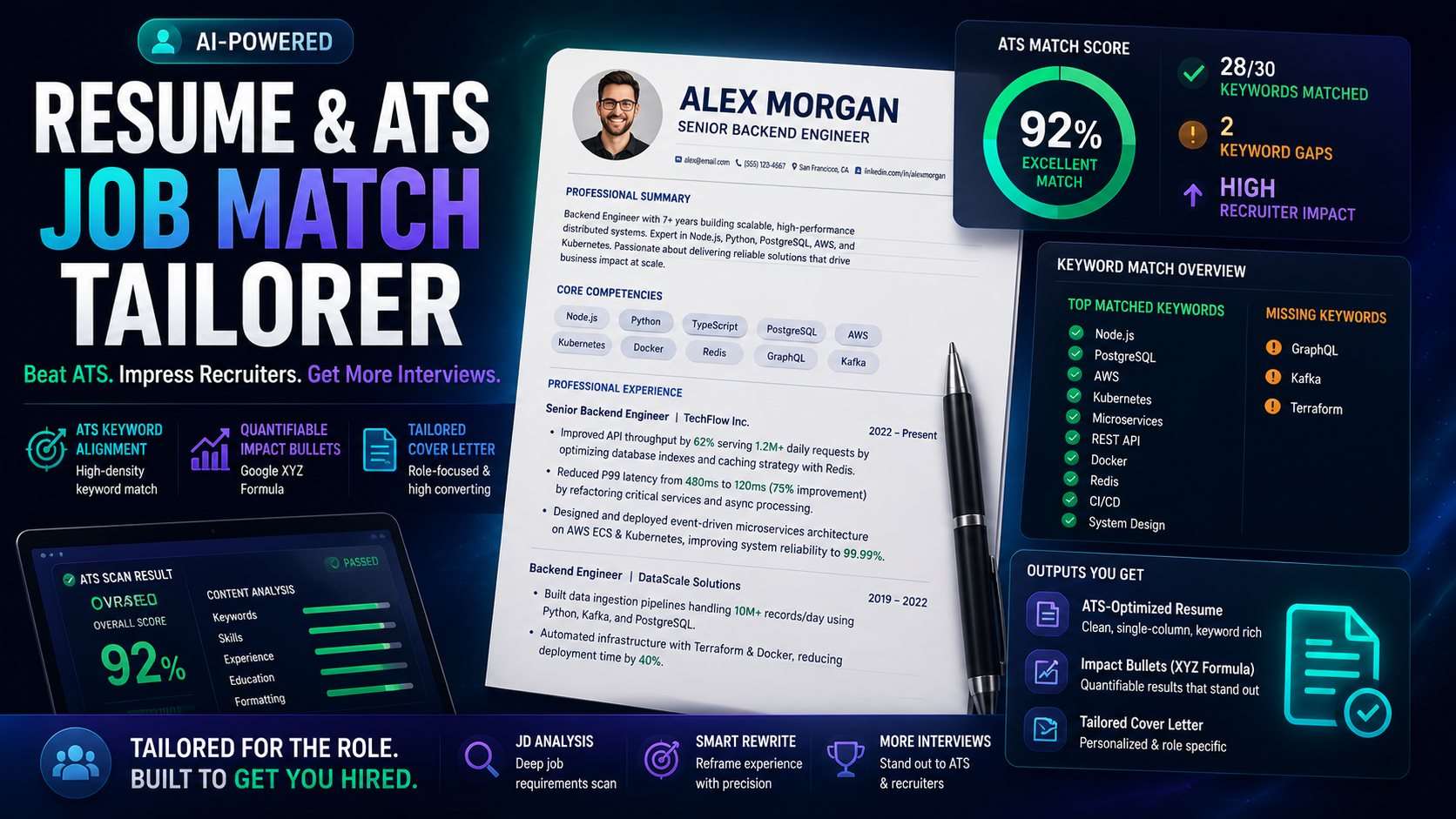
ATS resume keyword optimization for developers means treating the resume as structured data first, narrative second. The Resume & ATS Job Match Tailorer skill (resume-ats-tailorer) automates that structuring in five phases: ingest the JD and master resume, calculate a keyword overlap score, rewrite bullets with the XYZ formula, assemble a clean Markdown resume, and draft a matching cover letter.
1. Ingest the Job Description and Master Resume
Phase 1 pulls two inputs: the candidate's master resume (or LinkedIn export) and the target job description. From the JD, the skill extracts hard requirements, required languages and frameworks, minimum years of experience, cloud architecture expectations, and any stated domain constraints. This extraction step matters because everything downstream (the overlap score, the rewritten bullets) is scored against exactly these terms, not against a generic list of "popular tech skills."
2. Calculate the Keyword Coverage Ratio (Not an ATS Score)
Phase 2 runs a deterministic calculation rather than a subjective read of "how well the resume fits", and it's worth being precise about what this number is: a lexical-overlap indicator, not a prediction of how any real ATS will actually score or rank the resume, since real ATS scoring logic is proprietary and varies by vendor:
$$\text{Keyword Coverage Ratio} = \frac{|\text{Candidate Competencies} \cap \text{Required JD Keywords}|}{|\text{Required JD Keywords}|} \times 100\%$$
The output separates into two lists:
| Output | What It Contains | Example |
|---|---|---|
| Identified Matches | Core required technologies already present in the candidate's profile | Next.js 15, PostgreSQL, Kubernetes |
| Identified Gaps | Critical terms from the JD missing from the resume, flagged for authentic reframing | A JD requiring "event-driven architecture" when the candidate's experience is described only as "message queues" |
A gap does not mean inventing experience. It means checking whether the candidate already did the work under different vocabulary and rewording it honestly.
3. Rewrite Bullets with the Google XYZ Formula
Phase 3 is where most resumes lose the most ground. Task-based bullets read like a job description, not an achievement. The skill converts each one into the XYZ structure, "Accomplished [X], as measured by [Y], by doing [Z]":
<!-- Before (Weak & Task-Oriented) -->
- Responsible for fixing database performance issues and updating queries.

<!-- After (Quantifiable XYZ Impact) -->
- Accelerated backend API throughput by 62% across 1.2M daily transactions by refactoring nested ORM queries into composite B-Tree indexes and Redis cache layers.
The rule enforced here (Core Rule #3 in the skill) is strict: every primary bullet must carry at least one measurable metric, a percentage, a latency figure, a dollar value, or a scale number. "Improved performance" is not a bullet. "Reduced query latency by 45% on a 10M-row PostgreSQL cluster" is.
4. Assemble the ATS-Optimized Resume
Phase 4 outputs a single, clean Markdown resume with four sections: a professional summary under three sentences, a categorized technical competencies block (languages, frameworks, cloud/DevOps, databases), three to five high-impact bullets per role, and education/certifications. The formatting constraint is deliberate, no tables, no multi-column layouts, no embedded graphics, because those elements are exactly what causes ATS parsers to scramble or drop resume content.
5. Draft the Tailored Cover Letter
Phase 5 produces a roughly 200-word cover letter built around two specific technical achievements, chosen to address the hiring manager's stated challenge in the JD rather than restate the resume. A cover letter that repeats the resume adds nothing; one that answers "why does this achievement solve your specific problem" does.
The Zero Falsification Rule
Every phase runs under one non-negotiable constraint: the skill never invents experience that did not happen. Gaps identified in Phase 2 get closed by reframing real past work in stronger, more precise industry vocabulary, not by fabricating a technology the candidate never touched. This is the difference between resume tailoring and resume fraud, and it is enforced as a hard invariant, not a suggestion.
Frequently Asked Questions
How does ATS resume keyword optimization actually get calculated?
The skill parses the job description for required technologies and qualifications, compares them against the candidate's documented competencies, and computes Matched Keywords divided by Total Required JD Keywords, multiplied by 100 — a deterministic percentage, not a subjective score.
What is the Google XYZ formula for resume bullets?
It restructures each bullet as "Accomplished [X], as measured by [Y], by doing [Z]" — for example, "Reduced database query latency by 45% (Y) on a 10M-row PostgreSQL cluster (X) by architecting composite B-Tree indexes (Z)."
Does the output stay ATS-friendly, or does it just look good to a human?
The generated resume is single-column standard Markdown with no tables, no multi-column layouts, and no icons or graphics — the formatting choices most likely to break ATS parsing are excluded by design.
Comments
Comments are reviewed before appearing publicly.
No comments yet — be the first.