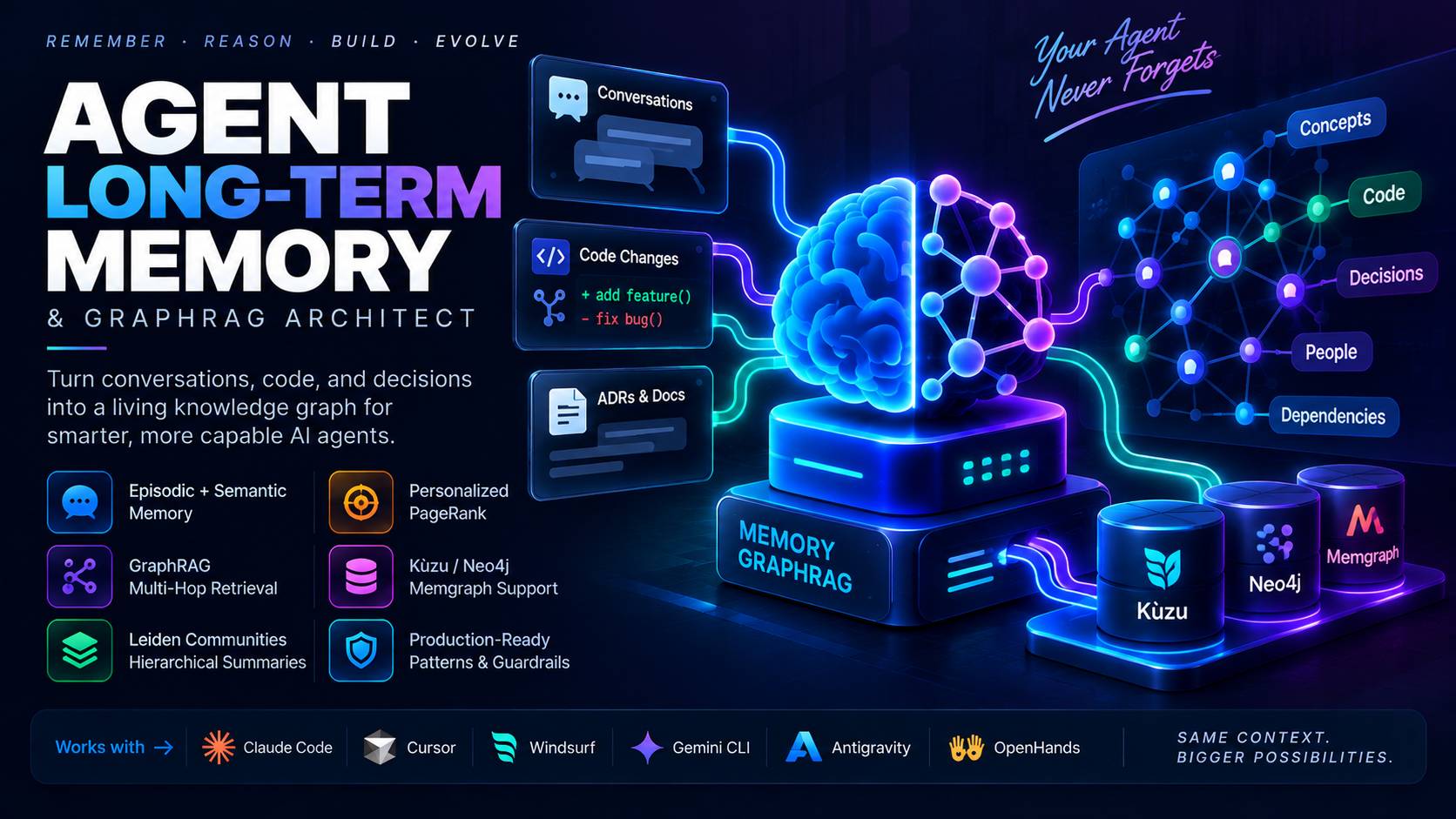
Standard vector search fails autonomous AI agents when questions require multi-step reasoning across time.
If an agent needs to know why an architecture decision was made three weeks ago, pure cosine similarity over chunked text embeddings falls short. It retrieves chunks containing the phrase "Postgres migration," but completely misses the unmentioned causal link connecting a database dead-lock incident, an ADR document, and a subsequent configuration tweak.
This is the multi-hop reasoning gap. To give coding agents true persistent memory, modern systems combine episodic conversational logging with knowledge graphs using GraphRAG and HippoRAG principles.
Here is how to design an embedded GraphRAG memory engine using in-process graph databases like Kùzu alongside Personalized PageRank for fast, multi-hop context retrieval.
Why Vector Embeddings Break on Agent Workflows
In typical agent execution loops, context accumulates quickly. If you dump raw conversational turns into a vector database, three specific issues arise:
| Evaluation Dimension | Standard Vector Store (Chroma / Pinecone) | GraphRAG Engine (Kùzu / Neo4j) |
|---|---|---|
| Multi-Hop Traversal | Fails: cannot connect $A \to B \to C$ unless stated in one chunk | Native: executes graph walks across arbitrary edge depths |
| Temporal Invariants | Overwrites or confuses outdated architectural decisions | Preserves time-stamped edges (DECIDED_IN, SUPERSEDED_BY) |
| Footprint on Local Dev | Requires external service or heavy background process | Runs in-process via C++ bindings with sub-millisecond lookups |
| Context Extraction | Blind top-$K$ text chunks containing irrelevant noise | Subgraph extraction returning exact dependency subtrees |
When an engineer asks an agent, "What changed in our payment flow after the Stripe webhook incident?", the answer requires traversing from the incident log to the relevant commit, then to the modified API handler. Graph structures capture this path naturally.
Defining Typed Knowledge Triplet Schemas
The first step in building graph memory is defining a schema that represents both code components and developer intent. Using Kùzu's native Cypher DDL, you can define nodes and relationships directly in Python:
import kuzu

# Initialize an in-process graph database directory
db = kuzu.Database("./agent_memory_db")
conn = kuzu.Connection(db)

# Create schema tables for software components and decisions
conn.execute("""
    CREATE NODE TABLE IF NOT EXISTS Component(
        name STRING,
        type STRING,
        filepath STRING,
        PRIMARY KEY(name)
    );
""")

conn.execute("""
    CREATE NODE TABLE IF NOT EXISTS Decision(
        id STRING,
        reason STRING,
        timestamp INT64,
        PRIMARY KEY(id)
    );
""")

conn.execute("""
    CREATE REL TABLE IF NOT EXISTS DEPENDS_ON(
        FROM Component TO Component,
        weight DOUBLE
    );
""")

conn.execute("""
    CREATE REL TABLE IF NOT EXISTS DECIDED_IN(
        FROM Component TO Decision,
        context STRING
    );
""")
Extracting Triplets from Git Diffs and Architecture Records
When an agent finishes a task, an ingestion worker parses the session delta and extracts structured triplets:
def record_architectural_decision(
    conn: kuzu.Connection,
    component_name: str,
    decision_id: str,
    reason: str,
    timestamp: int
):
    # Insert or update nodes
    conn.execute(
        "MERGE (c:Component {name: $name, type: 'service', filepath: 'src/services'})",
        {"name": component_name}
    )
    conn.execute(
        "MERGE (d:Decision {id: $id, reason: $reason, timestamp: $ts})",
        {"id": decision_id, "reason": reason, "ts": timestamp}
    )
    # Bind the relationship
    conn.execute("""
        MATCH (c:Component {name: $name}), (d:Decision {id: $id})
        MERGE (c)-[:DECIDED_IN {context: 'architecture_change'}]->(d)
    """, {"name": component_name, "id": decision_id})
Multi-Hop Context Retrieval with Graph Algorithms
When a user prompts the agent with a complex query, the system identifies initial seed nodes, then runs Personalized PageRank (PPR) to find related nodes that share structural relevance:
[User Query]
    │
    ▼
Seed Entity: "AuthService"
    │
    ├── (DEPENDS_ON) ──> "SessionStore" (Edge Weight: 0.9)
    │                         │
    │                         └── (CONFIGURED_BY) ──> "RedisCluster" (Weight: 0.8)
    │
    └── (DECIDED_IN) ──> "ADR-042: Remove JWT in favor of HttpOnly Cookie"
Instead of pulling forty disconnected paragraphs into prompt context, the graph traversal pulls an exact, structured subgraph. The LLM receives the precise historical rationale and code dependency chain without hallucinating connections.
Frequently Asked Questions
Why use Kùzu instead of Neo4j for local coding agents?
Kùzu is an embedded, in-process graph engine built in C++, similar to SQLite for relational data. It runs directly inside your agent script without requiring Docker containers or external cloud databases.
Does GraphRAG replace vector databases entirely?
No. The most effective implementations use hybrid architectures: vector search for fuzzy initial entity matching, followed by graph traversals for relational multi-hop reasoning.
How does this prevent memory decay in agents?
By attaching timestamps and lifecycle states (<code>ACTIVE</code>, <code>DEPRECATED</code>, <code>SUPERSEDED</code>) to relationships, old decisions remain queryable as historical context without contaminating active coding rules.
Comments
Comments are reviewed before appearing publicly.
No comments yet — be the first.