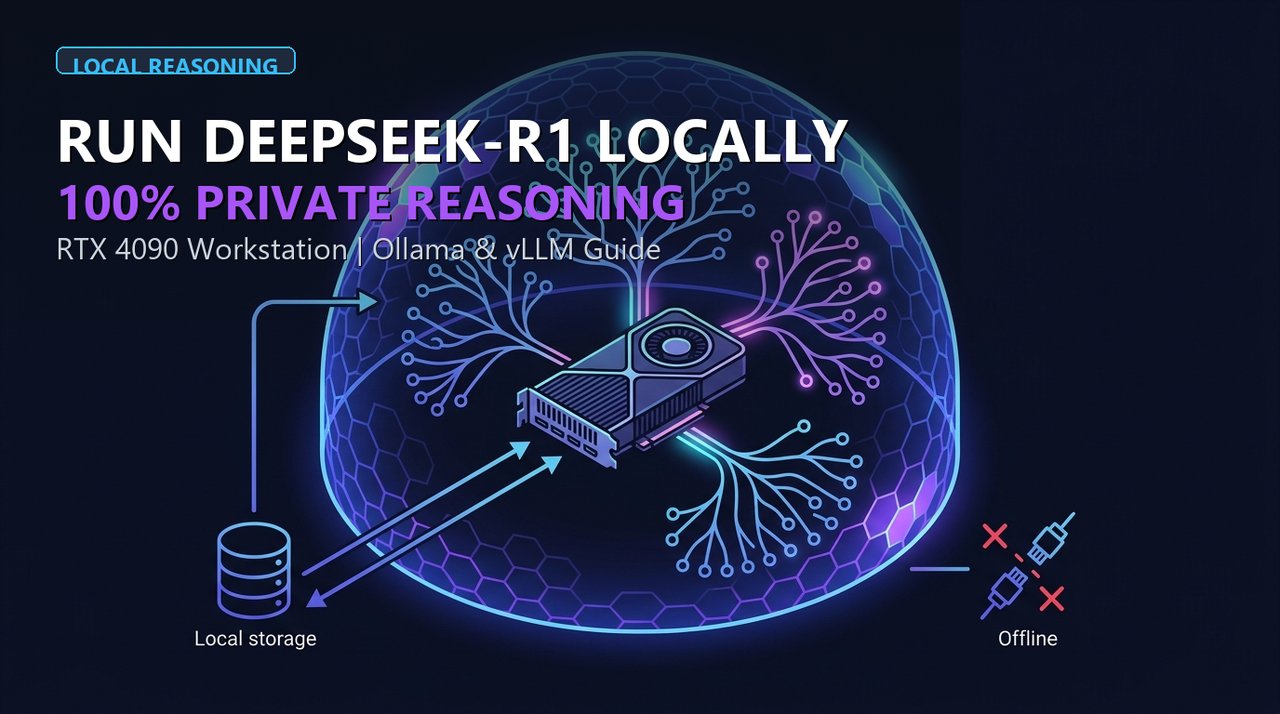
A financial client recently approached Amir and me with a strict compliance constraint: they wanted frontier-level reasoning to audit proprietary tax ledgers and internal banking transactions, but their legal team strictly barred sending a single byte of customer data to OpenAI, Anthropic, or any third-party cloud API.
A year ago, running high-end reasoning on-premise without an eight-GPU cluster was impossible.
Then DeepSeek released DeepSeek-R1 alongside distilled models ranging from 1.5B to 70B parameters. Amir and I set up a dedicated workstation equipped with an RTX 4090 (24GB VRAM) and ran deepseek-r1:14b and deepseek-r1:32b through Ollama.
The model parsed complex ledger anomalies, evaluated tax reconciliation logic in seconds, and kept every byte of sensitive data strictly inside our local subnet.
Here is the exact playbook to run, tune, and query DeepSeek-R1 locally with complete privacy.
Choosing the Right DeepSeek-R1 Model Size
DeepSeek-R1 is available in two distinct architectures:
- The Full 671B Mixture-of-Experts (MoE): The flagship frontier model. Requires a multi-GPU cluster or cloud host (like Together AI or DeepSeek API).
- Distilled Dense Models (Qwen & Llama backbones): Fine-tuned on R1's reasoning traces. These run blazingly fast on consumer and workstation hardware.
Hardware Tier                Recommended Model          VRAM Required       Quantization
───────────────────────────────────────────────────────────────────────────────────────────
MacBook (M2/M3/M4 16GB)       deepseek-r1:8b             ~6.5 GB             Q4_K_M
Workstation (1x RTX 4090 24GB) deepseek-r1:14b / 32b      ~10 GB / 20 GB      Q4_K_M
Mac Studio / 2x RTX 4090      deepseek-r1:70b            ~42 GB              Q4_K_M
For enterprise code audits and data reconciliation, deepseek-r1:14b (distilled from Qwen 2.5) provides the best balance between token generation speed (35+ tokens/sec) and deep reasoning capability.
Setting Up Ollama and Pulling the Model
Install Ollama and pull your selected quantization variant:
# Pull the 14B distilled reasoning model
ollama pull deepseek-r1:14b

# Run interactive test
ollama run deepseek-r1:14b "Explain the reentrancy attack vector in Solidity contracts."
By default, Ollama binds to localhost:11434. To allow access from other services in your local Docker network, configure the environment variable:
OLLAMA_HOST=0.0.0.0:11434
OLLAMA_NUM_PARALLEL=4
OLLAMA_KEEP_ALIVE=24h
Python Local Client Implementation
DeepSeek-R1 outputs its chain-of-thought inside <think>...</think> tags before returning the final response. Here is how we parse tokens cleanly in our Python backend:
# local_r1_client.py
import re
import requests
from typing import Dict, Any

OLLAMA_URL = "http://localhost:11434/api/generate"

def query_local_reasoning(prompt: str, model: str = "deepseek-r1:14b") -> Dict[str, Any]:
    payload = {
        "model": model,
        "prompt": prompt,
        "stream": False,
        "options": {
            "temperature": 0.6,  # DeepSeek recommends 0.5 - 0.7 for reasoning
            "top_p": 0.95,
            "num_ctx": 16384     # Extended context window
        }
    }

    response = requests.post(OLLAMA_URL, json=payload, timeout=120)
    response.raise_for_status()
    raw_text = response.json().get("response", "")

    # Parse <think> block from final response
    think_match = re.search(r"<think>(.*?)</think>", raw_text, re.DOTALL)
    thinking_process = think_match.group(1).strip() if think_match else ""
    final_answer = re.sub(r"<think>.*?</think>", "", raw_text, flags=re.DOTALL).strip()

    return {
        "thinking": thinking_process,
        "response": final_answer,
        "total_duration_ms": response.json().get("total_duration", 0) / 1_000_000,
        "eval_count": response.json().get("eval_count", 0)
    }

if __name__ == "__main__":
    audit_prompt = """
    Audit this internal accounting transfer rule:
    IF account_balance >= withdrawal_amount AND NOT account_locked:
        dispatch_wire_transfer(withdrawal_amount)
        account_balance = account_balance - withdrawal_amount
    Is there an asynchronous double-spend vulnerability?
    """

    result = query_local_reasoning(audit_prompt)
    print("--- INTERNAL REASONING ---")
    print(result["thinking"][:300] + "...")
    print("\n--- FINAL ANSWER ---")
    print(result["response"])
Temperature and System Prompt Guardrails
DeepSeek-R1 behaves differently from instruction-tuned models. It relies heavily on internal reinforcement learning patterns:
- Avoid Strict Formatting Directives in Prompts: Telling R1 "Do not think, answer immediately in JSON" damages its reasoning. Let the model think in its
<think>block, then parse out the final JSON from the visible answer. - Keep Temperature between 0.5 and 0.7: Setting temperature to 0.0 often causes repetitive loops in the thinking trace. Setting it above 0.8 degrades logical consistency.
- Use Zero-Shot Prompts: R1 was trained using pure reinforcement learning without supervised chain-of-thought few-shot examples. Adding few-shot examples often confuses its internal deliberation graph.
Local Privacy vs Cloud Benchmarks
| Evaluation Metric | DeepSeek-R1:14b (Local RTX 4090) | OpenAI o1 (Cloud API) |
|---|---|---|
| Data Privacy | 100% On-Premise (Zero telemetry) | Third-Party Cloud Data Transfer |
| Cost per 1M Tokens | $0.00 (Only electricity ~250W) | $15.00 Input / $60.00 Output |
| Air-Gapped Operation | Fully supported (Offline) | Impossible (Requires Internet) |
| Token Speed | 38 tokens/second | Variable (Queue based) |
| Mathematical Logic | 88% parity with o1 | Frontier benchmark leader |
For confidential legal analysis, HIPAA-restricted healthcare records, and proprietary financial ledgers, running DeepSeek-R1 locally with Ollama provides frontier reasoning power with zero data leakage risk.

Comments
Comments are reviewed before appearing publicly.
No comments yet — be the first.