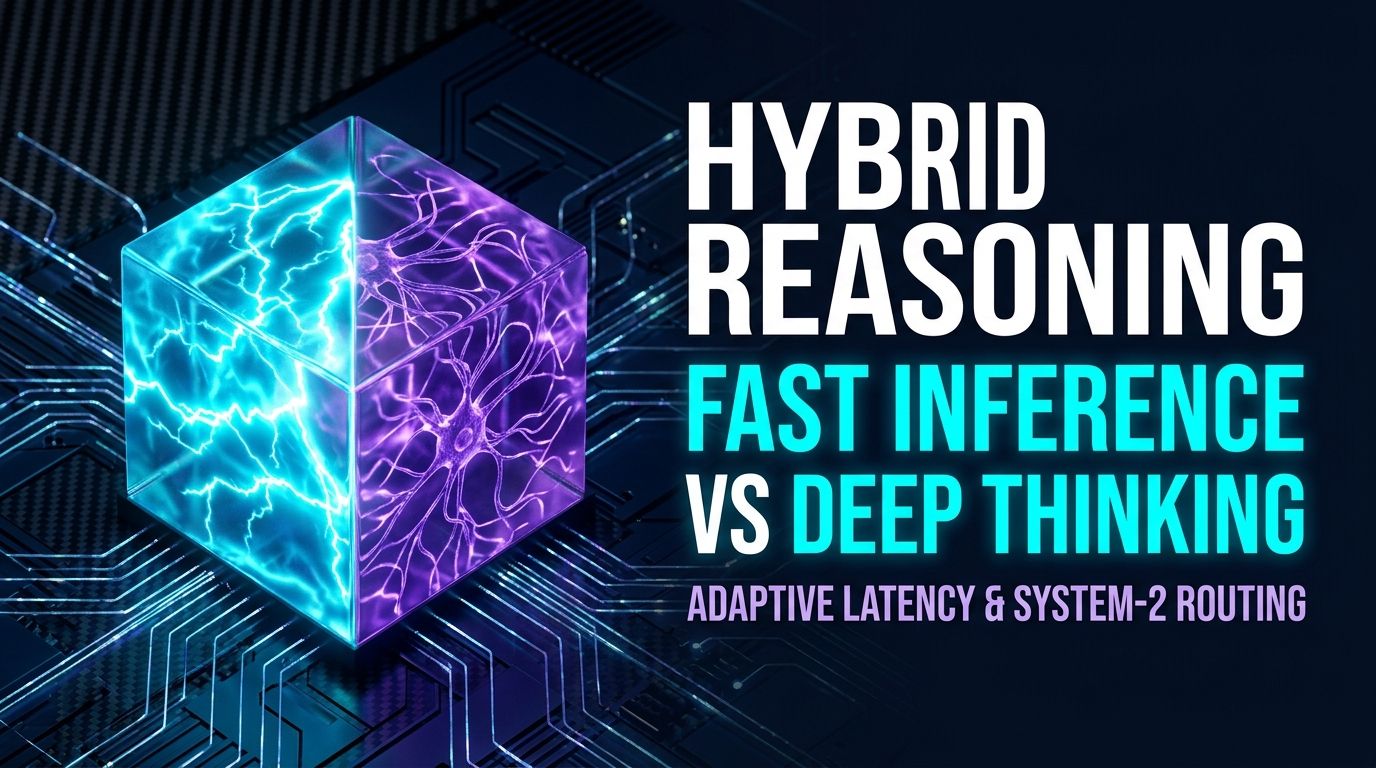
Until recently, picking a model meant picking a tradeoff you couldn't undo per request: a fast model that falls apart on anything genuinely hard, or a reasoning model that spends forty seconds drafting an internal chain of thought before replying to "hi." Hybrid reasoning models remove that either-or. The same endpoint can run with zero thinking tokens for routing a simple message, or a few thousand when it's actually refactoring an auth protocol, and you control which.
What Actually Happens Inside a Thinking Phase
In a normal autoregressive model, every token you see is predicted straight from the prompt. A hybrid reasoning model inserts a hidden phase in between.
First, it reads the task and estimates how much it actually needs to reason before answering. If thinking is enabled, it writes a scratchpad you don't see, working through assumptions, testing approaches, catching a race condition before it ever shows up in the visible reply. Only after that does it synthesize the final response from whatever the scratchpad settled on.
The part worth remembering: those hidden thinking tokens are billed the same as visible output tokens. Turning this dial up or down has a direct line to your monthly API bill.
Three Tiers of Reasoning Control
| Standard model (no scratchpad) | Fixed reasoning (always deep) | Hybrid (configurable per request) | |
|---|---|---|---|
| Thinking budget | None | Fixed, and opaque to you | Set per call, from zero up to a large ceiling |
| Response starts | Fast | Slow, even for easy questions | Fast when you ask for fast, slow when you ask for deep |
| Cost behavior | Scales with response length only | High baseline on every single call | Scales with the problem, not the endpoint |
| Best for | Simple routing, classification | Nothing, really, it's rarely the right default | Everything, if you tune the budget per task type |
Setting the Budget by Task, Not Guesswork
The mistake most teams make is picking one static thinking budget for the whole app. A better pattern maps budget to what the task actually needs:
import os
from anthropic import Anthropic

client = Anthropic(api_key=os.environ.get("ANTHROPIC_API_KEY"))

BUDGET_BY_TASK = {
    "classification": 0,       # instant, no scratchpad needed
    "crud_generation": 1024,   # light logic check
    "security_audit": 4096,    # worth the depth
    "compiler_debug": 8192,    # exhaustive state tracing
}

def run_task(prompt: str, task_type: str):
    budget = BUDGET_BY_TASK.get(task_type, 1024)

    if budget == 0:
        return client.messages.create(
            model="claude-3-7-sonnet-20250219",
            max_tokens=2048,
            messages=[{"role": "user", "content": prompt}],
        ).content

    return client.messages.create(
        model="claude-3-7-sonnet-20250219",
        max_tokens=4096 + budget,
        thinking={"type": "enabled", "budget_tokens": budget},
        messages=[{"role": "user", "content": prompt}],
    ).content
Two things will bite you if you skip them. max_tokens has to exceed budget_tokens, or the model burns its whole allowance thinking and never gets to write the actual answer. And once a thinking budget goes past a couple thousand tokens, stream the response, otherwise your users are staring at a spinner with no signal anything is happening.
Where This Goes Wrong in Production
Giving a large thinking budget to an easy task doesn't make the answer better, it just makes the model second-guess a question that didn't need it, and the response comes back more convoluted for no benefit. On the other end, a genuinely hard problem can hit the token ceiling mid-reasoning and get cut off with an incomplete answer, worse than if it had never started reasoning at all. And if you're adding deep reasoning to something latency-sensitive, autocomplete, a live chatbot, you'll feel it as a stall, not a feature. Keep reasoning-heavy calls off the interactive path.
If your team is burning budget because every request runs at the same thinking depth regardless of what it actually needs, that's usually a half-day fix once someone maps task types to budgets properly. SmartBuddy can audit and set this up for you →
Frequently Asked Questions
Do thinking tokens count against my rate limit?
Yes, both your token-per-minute rate limit and your bill, even though you never see them in the chat interface.
Can I actually see what the model was thinking?
Depending on the API, yes, thinking content can come back as a structured block you can log and audit before you trust the final answer.
When is zero thinking the right call?
For anything where the schema or logic is already enforced elsewhere, classification, simple translation, routing a conversational greeting, standard queries against a known schema. Paying for reasoning there just adds latency for no gain.
Comments
Comments are reviewed before appearing publicly.
No comments yet — be the first.