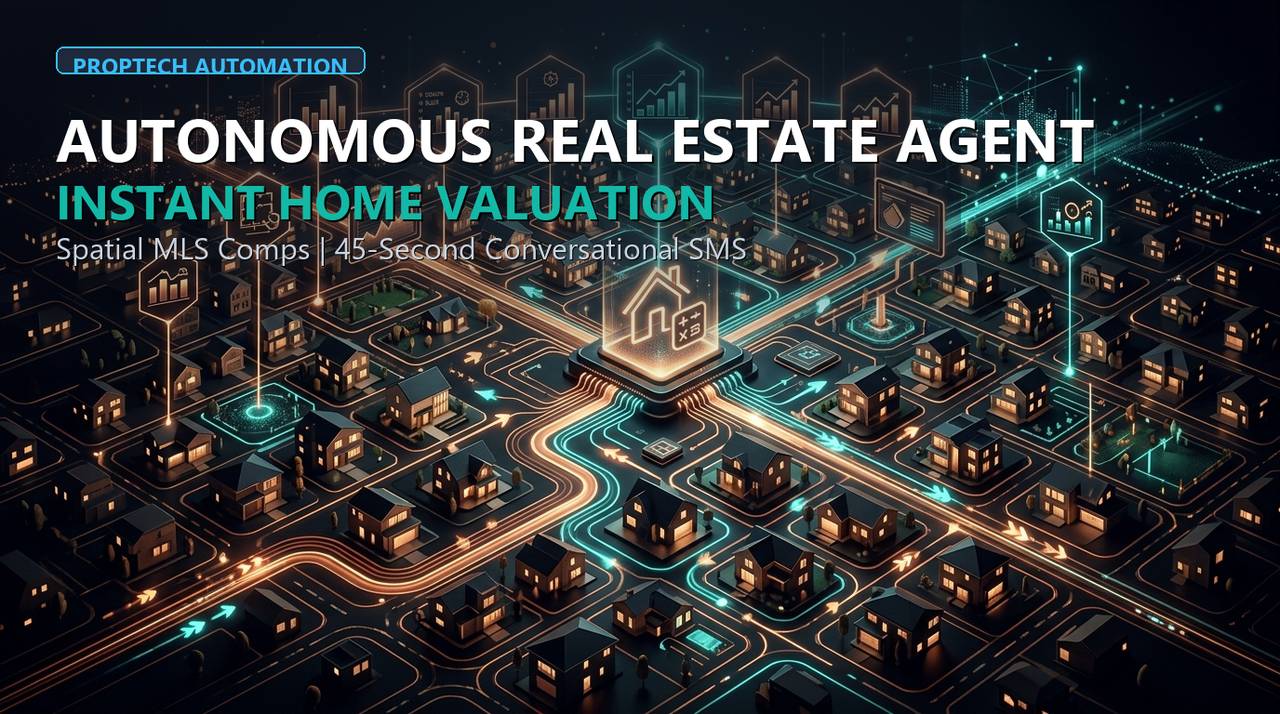
In real estate, lead response time makes or breaks deals. If a prospective home seller fills out a valuation inquiry on an agency website and waits two hours for an agent to call back, the odds of booking an appointment drop by 390%.
Last winter, Amir and I partnered with a boutique residential brokerage. Their human sales agents spent fifteen hours a week pulling recent comparable sales (comps) from the Multiple Listing Service (MLS), adjusting square footage math in spreadsheets, and calling back cold leads who had already moved on.
We automated their entire lead capture and intake workflow with an autonomous PropTech agent.
When a homeowner submits their address, our agent normalizes the tax parcel data, queries comparable sales within a 1.5-mile radius, runs a price-per-square-foot regression model, and delivers a customized valuation range to the seller via SMS in 45 seconds. Response rates leaped from 18% to 64%.
Here is the step-by-step engineering blueprint to build a real estate valuation and intake agent.
System Architecture: From Inbound Address to Valuation SMS
Homeowner Inquires via Web / SMS
               │
               ▼
Address Geocoding & Municipal Tax Parcel Lookup
               │
               ▼
Spatial Vector Query: Top 5 Comps within 1.5 miles (Sold in past 180 days)
               │
               ▼
Automated Valuation Model (AVM) Regression Adjustments
               │
               ▼
Claude Narrative Synthesis (Personalized Neighborhood Insights)
               │
               ▼
SMS Dispatch via Twilio + CRM Opportunity Created in HubSpot
The system combines deterministic geographical spatial queries with an LLM narrative generator. The numbers come from math; the conversational relationship starts with the narrative.
Automated Comparable Sales (Comps) Valuation in Python
Raw average square foot prices mislead sellers because properties have different bedrooms, bathrooms, and lot sizes. We apply linear appraisal adjustments:
# proptech_valuation.py
from dataclasses import dataclass
from typing import List, Dict, Any
import numpy as np

@dataclass
class Property:
    address: str
    sqft: int
    bedrooms: int
    bathrooms: float
    lot_sqft: int
    sold_price: float
    distance_miles: float

class ValuationEngine:
    def __init__(self, target_property: Dict[str, Any]):
        self.target = target_property

    def calculate_adjusted_valuation(self, comps: List[Property]) -> Dict[str, Any]:
        """Calculates property valuation range using standardized appraisal adjustments."""
        if not comps:
            raise ValueError("At least 3 comparable sales required for valuation.")

        adjusted_prices = []

        for comp in comps:
            price = comp.sold_price

            # Adjustment: $110 per sqft difference
            sqft_diff = self.target["sqft"] - comp.sqft
            price += sqft_diff * 110.0

            # Adjustment: $15,000 per bedroom difference
            bed_diff = self.target["bedrooms"] - comp.bedrooms
            price += bed_diff * 15000.0

            # Adjustment: $10,000 per bathroom difference
            bath_diff = self.target["bathrooms"] - comp.bathrooms
            price += bath_diff * 10000.0

            adjusted_prices.append(price)

        median_estimate = float(np.median(adjusted_prices))
        valuation_low = round(median_estimate * 0.96, -3)
        valuation_high = round(median_estimate * 1.04, -3)

        return {
            "estimated_market_value": round(median_estimate, -3),
            "valuation_range_low": valuation_low,
            "valuation_range_high": valuation_high,
            "comps_count": len(comps),
            "confidence_score": "High" if len(comps) >= 4 else "Moderate"
        }
Conversational Lead Intake Agent
Once the valuation math completes, the agent drafts a conversational, low-pressure SMS to schedule a walkthrough:
# lead_intake_agent.py
import json
from anthropic import Anthropic

client = Anthropic()

def generate_lead_outreach_sms(
    seller_name: str,
    address: str,
    valuation_data: dict,
    neighborhood_trend: str
) -> str:
    prompt = f"""
    You are Maya, an intake coordinator for a boutique residential brokerage.

    Data:
    - Seller Name: {seller_name}
    - Address: {address}
    - Estimated Range: ${valuation_data['valuation_range_low']:,.0f} - ${valuation_data['valuation_range_high']:,.0f}
    - Local Trend: {neighborhood_trend}

    GOAL:
    Draft an SMS message under 280 characters.
    - Mention their estimated valuation range.
    - Mention one concrete neighborhood data point.
    - Ask a friendly qualifying question about recent home updates (kitchen/roof).
    - Do not sound like a spam bot.
    """

    response = client.messages.create(
        model="claude-sonnet-5",
        max_tokens=150,
        messages=[{"role": "user", "content": prompt}]
    )

    return response.content[0].text.strip()
Sample Generated SMS: > "Hi Marcus! Based on 4 recent sales on Elm Street, your home at 742 Evergreen is estimated between $485k and $525k. Neighborhood prices are up 4% this quarter. Have you completed any kitchen or bathroom renovations recently?"
Multi-Channel Lead State Machine
Lead intake is an ongoing dialogue, not a one-off notification. We track customer replies using this lightweight state machine:
[ Lead Created ] ──► [ SMS Sent (< 60s) ]
                            │
              ┌─────────────┴─────────────┐
              ▼                           ▼
      [ Seller Replies ]          [ No Reply (24h) ]
              │                           │
              ▼                           ▼
[ Classify Intent with LLM ]      [ Follow-up Nudge #1 ]
       ├── High Intent (Wants Walkthrough) ──► Instant Call Forwarding to Senior Broker
       ├── Medium Intent (Curious on Price) ──► Send 3-Page Detailed PDF Comps Report
       └── Disqualified (Renter/Wrong Num) ──► Archive Record in CRM
Production Lessons from Real Estate Automation
Amir and I gathered these practical takeaways from running this agent in production:
- Always Give a Range, Never an Exact Number: Homeowners will treat an exact number ($512,430) as a binding offer. A bounded range ($495k - $525k) sets realistic expectations and invites a conversation with an agent to refine the valuation.
- Handle Tax Parcel Quirks: Municipal county records often label basements as living area. Always filter comps on above-grade square footage to prevent distorted estimates.
- Speed to Lead is Everything: Delivering the estimate within 60 seconds captures the seller while they are still sitting at their computer or holding their phone.
Automating real estate intake frees human agents from manual MLS data collection and ensures prospective clients receive immediate, intelligent attention.





Comments
Comments are reviewed before appearing publicly.
No comments yet — be the first.