Last quarter, a startup founder told Amir and me: "We need to fine-tune Llama 3 on our entire company Notion workspace so the AI knows our product roadmap."
We had to gently stop him. Fine-tuning a language model to teach it factual, rapidly-changing company documentation is one of the most expensive mistakes an engineering team can make. Two weeks later when a product manager updates a roadmap deadline or deletes a feature, the fine-tuned weights are immediately obsolete.
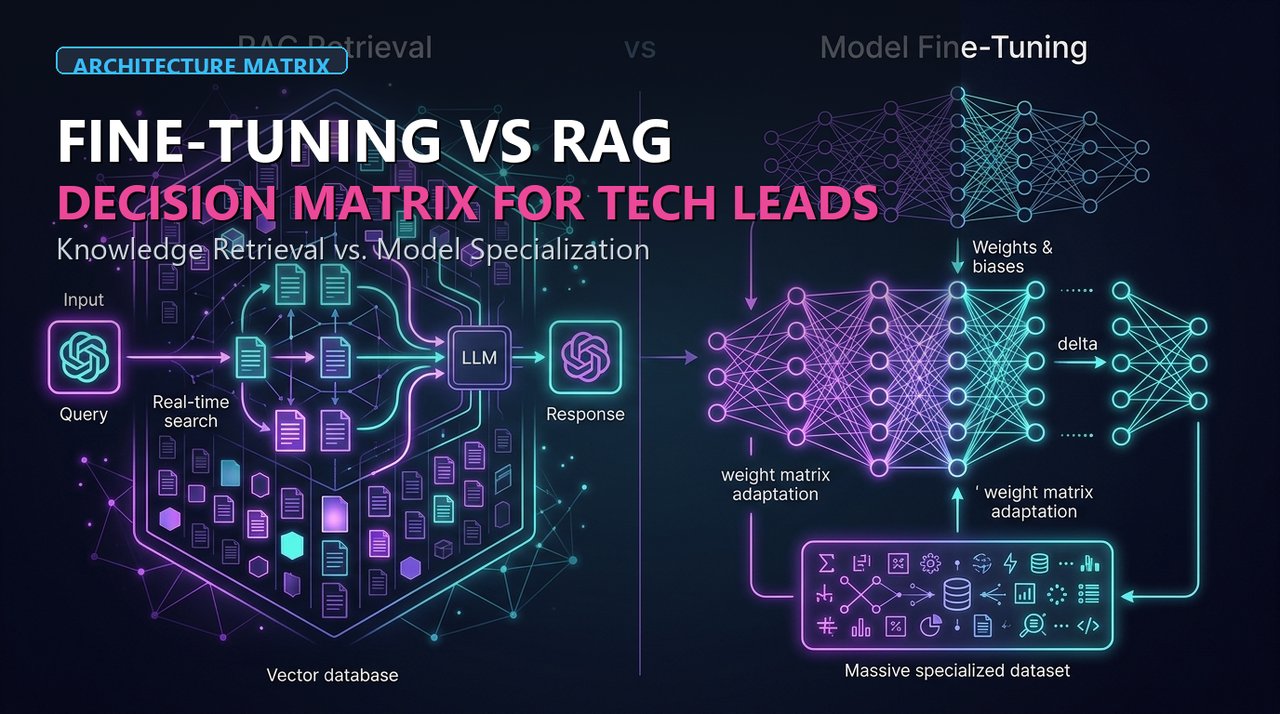
Fine-tuning teaches a model how to behave, style, and structure output. Retrieval-Augmented Generation (RAG) gives a model the facts and context it needs for a specific question.
Amir and I have deployed both architectures in production across dozens of applications. Here is the decision matrix we use to pick between RAG, Fine-Tuning, or a hybrid combination.
The Core Architectural Distinction
┌─────────────────────────────────────────────────────────────┐
│                       RAG (Retrieval)                       │
│  Goal: Inject factual, up-to-date knowledge at query time.  │
│  Best for: Company wikis, user data, dynamic product catalogs│
│  Updating cost: Instant (just update vector DB or search)   │
└─────────────────────────────────────────────────────────────┘
                               ▲
                               │ Different Architectural Focus
                               ▼
┌─────────────────────────────────────────────────────────────┐
│                    Fine-Tuning (Weights)                    │
│  Goal: Teach specialized tone, domain syntax, or formatting.│
│  Best for: Medical coding, SQL dialects, proprietary JSON   │
│  Updating cost: High (re-train dataset & redeploy weights)  │
└─────────────────────────────────────────────────────────────┘- Use RAG when facts change frequently: If your data updates daily, weekly, or even hourly, fine-tuning is out of the question. RAG retrieves fresh data from a database or search index at the millisecond the user asks.
- Use Fine-Tuning when formatting and specialized vocabulary are strict: If you need a model to output an obscure internal domain-specific language (DSL), strict JSON schemas without system prompt bloat, or specific corporate brand tone, fine-tuning modifies the model's baseline instincts.
The 5-Point Evaluation Decision Framework
Before writing a single training script or setting up a Pinecone index, answer these five questions:
| Dimension | Choose RAG | Choose Fine-Tuning |
|---|---|---|
| 1. Data Freshness | Changes daily or per-tenant | Static for months (e.g. medical terminology) |
| 2. Source Attribution | Mandatory (needs citations & links) | Unnecessary (just needs proper styling) |
| 3. Context Window Cost | Tolerates 4k - 20k tokens per prompt | Needs minimal tokens (wants 0-shot brevity) |
| 4. Hallucination Risk | Must be grounded in retrieved passages | Willing to trade grounding for domain intuition |
| 5. Engineering Budget | Fast initial prototype in 2 days | Weeks of data curation & GPU compute |
The Hybrid Pattern: When to Combine Both
In real-world enterprise deployments, the most resilient architecture is often not an either-or choice. It is a hybrid pipeline:
User Query: "Generate an HIPAA compliance audit report for Patient #4029"
        │
        ▼
Vector / Relational Retrieval (RAG)
Fetches: Live medical records, doctor visit notes, lab results
        │
        ▼
Fine-Tuned Smaller Model (e.g., Llama-3.1-8B Fine-Tuned on HL7/FHIR schemas)
Result: Formats retrieved facts into strict medical compliance JSON without prompt bloat
By combining RAG with a fine-tuned small model:
- RAG provides the truth: The patient's exact lab numbers are never stored in model weights.
- Fine-Tuning guarantees the schema: The 8B model outputs valid compliance syntax 100% of the time without requiring a 3,000-token system prompt.
Measuring Latency and Cost Trade-offs
Here is a Python benchmarking harness we use to evaluate cost per 1,000 queries between standard RAG with a large model and Fine-Tuning a compact model:
# architecture_cost_evaluator.py
from dataclasses import dataclass

@dataclass
class ArchitectureCost:
    name: str
    input_tokens: int
    output_tokens: int
    cost_per_m_input: float
    cost_per_m_output: float
    retrieval_cost_per_call: float = 0.0

    def cost_per_1k_requests(self) -> float:
        input_cost = (self.input_tokens / 1_000_000) * self.cost_per_m_input * 1000
        output_cost = (self.output_tokens / 1_000_000) * self.cost_per_m_output * 1000
        retrieval_cost = self.retrieval_cost_per_call * 1000
        return input_cost + output_cost + retrieval_cost

# Option A: RAG with Claude 3.5 Sonnet (Large system prompt + retrieved chunks)
rag_sonnet = ArchitectureCost(
    name="RAG + Claude 3.5 Sonnet",
    input_tokens=8500,
    output_tokens=600,
    cost_per_m_input=3.00,
    cost_per_m_output=15.00,
    retrieval_cost_per_call=0.002  # Vector DB compute
)

# Option B: Fine-Tuned Llama 3.1 8B (Minimal prompt, self-hosted on vLLM)
finetuned_llama = ArchitectureCost(
    name="Fine-Tuned Llama 3.1 8B",
    input_tokens=500,
    output_tokens=600,
    cost_per_m_input=0.15,
    cost_per_m_output=0.60,
    retrieval_cost_per_call=0.00
)

print(f"{rag_sonnet.name}: ${rag_sonnet.cost_per_1k_requests():.2f} per 1k calls")
print(f"{finetuned_llama.name}: ${finetuned_llama.cost_per_1k_requests():.2f} per 1k calls")
Output:
RAG + Claude 3.5 Sonnet: $36.50 per 1k calls
Fine-Tuned Llama 3.1 8B: $0.44 per 1k calls
If your query volume is 2 million calls per month and your task is primarily formatting, fine-tuning an 8B model saves over $70,000 every single month.
Architectural Checklist for Engineering Leads
Before committing your team to a multi-week fine-tuning sprint, run through this sanity checklist:
- Have you tested Few-Shot in-context learning first? If putting 3 good examples in your prompt solves 90% of the issue, do not fine-tune.
- Can you cite the exact source? If users or auditors demand to see the paragraph where the AI found an answer, you must use RAG. Model weights cannot provide verifiable URLs.
- Do you have at least 1,000 clean, human-verified input/output pairs? Fine-tuning on noisy or small datasets will degrade general reasoning.
- Is prompt caching an option? If prompt size is your only concern, prompt caching gives you fine-tuning latency and cost savings without modifying model weights.
Choose RAG for knowledge. Choose Fine-Tuning for specialization. Combine them when scale and precision demand both.

Comments
Comments are reviewed before appearing publicly.
No comments yet — be the first.