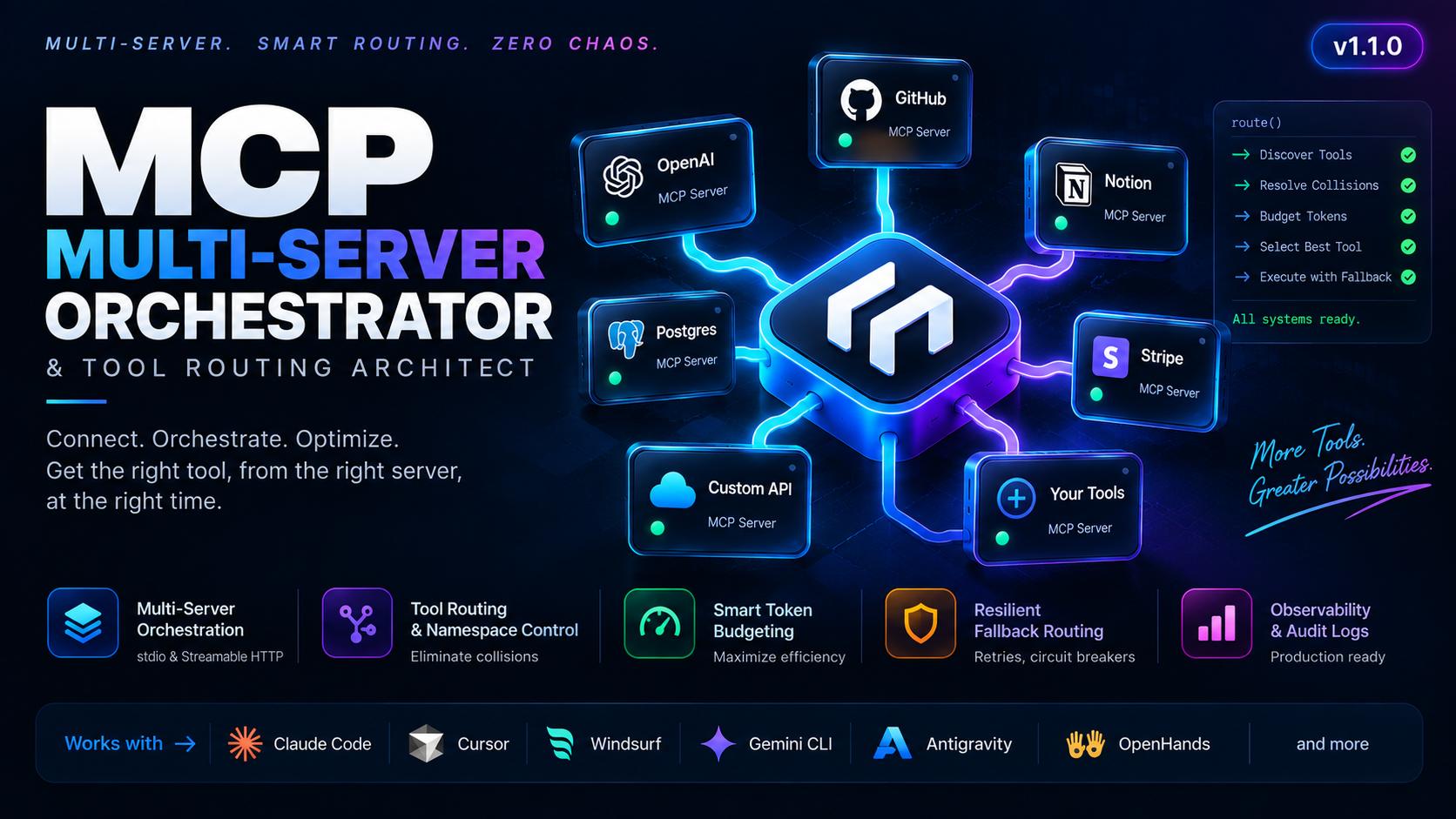
Connecting one Model Context Protocol (MCP) server to your development client is straightforward. You add an entry to your configuration JSON, define three tools, and your agent begins calling them.
The breakdown happens when your setup scales to five, eight, or twelve servers. Suddenly, your agent attempts to load sixty different tool definitions into its system prompt on turn zero. Tool definitions consume thousands of tokens before you even type your initial prompt.
Even worse, multiple servers export generic tool names like execute_query, read_file, or search. The agent experiences namespace collisions, mixes up parameter schemas, and hallucinates arguments between conflicting tools.
Here is how to architect an orchestrator layer that unifies stdio and Streamable HTTP transports, isolates namespaces with deterministic prefixes, and injects tool definitions just-in-time based on active intent.
The Anatomy of Multi-Server MCP Failure
When you wire multiple MCP servers directly into client configurations (claude_desktop_config.json, .cursor/mcp.json), the client concatenates every tool schema into a single flat array.
This introduces three failure modes:
| Failure Mode | Direct Multi-Server Attachment | With Orchestration & Router Middleware |
|---|---|---|
| Token Overhead | 8,000+ tokens loaded on every turn | 600 to 1,200 tokens injected just-in-time |
| Name Collisions | Second server overwrites first or causes LLM error | Deterministic prefixing (db_prod__query vs analytics__query) |
| Transport Latency | One stalled server blocks client startup | Asynchronous connection pooling with timeout isolation |
| Fault Recovery | Agent crashes on downstream socket drop | Circuit breaker marks server degraded and falls back |
The solution is placing an orchestrator middleware between your agent and your server fleet. Instead of pointing your client to ten different endpoints, point your client to one local orchestrator.
Deterministic Namespace Normalization
To stop conflicting tools from colliding in agent memory, the orchestrator sanitizes server identifiers and prefixes every exported tool name:
// Core Namespace Prefixing Pattern
export interface RawMcpTool {
  name: string;
  description?: string;
  inputSchema: Record<string, any>;
}

export interface SanitizedMcpTool extends RawMcpTool {
  originalName: string;
  serverId: string;
}

export function normalizeToolNamespace(serverId: string, tool: RawMcpTool): SanitizedMcpTool {
  const cleanServerId = serverId.toLowerCase().replace(/[^a-z0-9_]/g, '_');
  return {
    name: `${cleanServerId}__${tool.name}`,
    description: `[${serverId}] ${tool.description || 'No description provided.'}`,
    inputSchema: tool.inputSchema || { type: 'object', properties: {} },
    originalName: tool.name,
    serverId: cleanServerId
  };
}
When the LLM decides to call github_corp__create_issue, the orchestrator intercepts the call, strips the prefix, and routes the sanitized payload directly to the github_corp server process as create_issue. The foundation model sees clean separation, while downstream servers receive their native formats.
Just-In-Time Schema Pruning & Token Budgeting
Instead of dumping every tool schema into the system prompt, calculate a strict token budget for tool definitions. The orchestrator computes keyword overlap and cosine similarity between the user request and available tool descriptions, serving only the top $K$ relevant schemas:
User Prompt: "Run a read-only query on customer churn table and format to CSV"
                             │
                             ▼
              [Orchestrator Intent Classifier]
                             │
            ┌────────────────┴────────────────┐
            ▼                                 ▼
   [postgres__query (READ)]         [analytics__export_csv]
   Schema Injected (800 tokens)     Schema Injected (400 tokens)
            │                                 │
            └────────┬────────────────────────┘
                     ▼
       (15 other tools pruned from context)
By tagging each tool with an operational category (READ_ONLY, IDEMPOTENT, NON_IDEMPOTENT, DESTRUCTIVE), the router also blocks risky retries if a database write times out.
Production Circuit Breaker Implementation
When an external MCP service fails or hits API quotas, waiting for standard TCP timeouts freezes your agent session. The orchestrator wraps every execution call in a three-state circuit breaker:
type CircuitState = 'CLOSED' | 'OPEN' | 'HALF_OPEN';

export class McpCircuitBreaker {
  private state: CircuitState = 'CLOSED';
  private failureCount = 0;
  private lastFailureTime = 0;

  constructor(
    private readonly failureThreshold = 3,
    private readonly resetTimeoutMs = 30000
  ) {}

  public async execute<T>(action: () => Promise<T>): Promise<T> {
    const now = Date.now();

    if (this.state === 'OPEN') {
      if (now - this.lastFailureTime > this.resetTimeoutMs) {
        this.state = 'HALF_OPEN';
      } else {
        throw new Error('MCP Server Circuit is OPEN. Request dropped to preserve agent execution.');
      }
    }

    try {
      const result = await action();
      if (this.state === 'HALF_OPEN') {
        this.state = 'CLOSED';
        this.failureCount = 0;
      }
      return result;
    } catch (err) {
      this.failureCount++;
      this.lastFailureTime = now;
      if (this.failureCount >= this.failureThreshold) {
        this.state = 'OPEN';
      }
      throw err;
    }
  }
}
Frequently Asked Questions
Can I connect both local stdio and remote HTTP MCP servers together?
Yes. The orchestrator abstracts transport protocols, letting Claude Code or Cursor talk to a local Docker container via <code>stdio</code> while querying a cloud microservice via <code>Streamable HTTP</code> simultaneously.
Does namespace prefixing confuse Claude Code or Cursor?
No. Frontier models handle underscored prefixes naturally, provided the tool descriptions explain which server owns the tool.
How much context window does dynamic pruning save?
In setups with 40 or more tools, pruning reduces schema overhead from roughly 8,000 tokens down to under 1,500 tokens per execution step.

Comments
Comments are reviewed before appearing publicly.
No comments yet — be the first.